Showing posts with label factoring. Show all posts

Weird Analogies: The Halloween Candy Tax

If you spend much time in my classroom at all, you will quickly realize that I use lots of weird analogies.  Some analogies I use once and forget about.  Other times I start analogies without really thinking about them and end up regretting my decision.  And, sometimes, my analogies actually work and I end up being able to use them more than once.

I don't remember the first time I used this analogy, but I think it must have been during my first year of teaching.  My students were struggling with factoring the GCF out of an expression.  We were looking at problems like this:


It didn't take much convincing that we should factor an 8 out of both terms.  But, my students were insistent that we could only factor out one x and one y.  Once I convinced them that it was okay to factor out more than a single variable, many of them defaulted to wanting to factor out the number of variables from the first term.  So, in this example, they would want to factor out x to the eighth and y to the sixth.  Telling them that we wanted to factor out the greatest number of things they had in common didn't really seem to help.

So, analogy time it was.  Be forewarned.  I used this analogy with my students today, and it resulted in one class accusing me of being cruel and cold-hearted.  As long as something helps my students see math more clearly, I'm okay with them thinking crazy things about me.


So, today, the class is confused.  Frustrated.  Ready to give up.  Fixed mindset statements are being uttered at every turn.  And, I'm pretty sure most of my students would describe themselves as being in the panic zone.  I sit on top of an empty student desk, and I look around at my students.  Eventually they seem to sense that I have something to say:

Okay, everyone.  Listen up.  From walking around and listening to your conversations, I can tell that we're struggling.  I'm going to tell you a story.  Maybe it will help.  Maybe it won't.  Maybe you'll go home tonight and tell your parents what a crazy math teacher you have.  But, maybe, just maybe, it will help to shed some light on the problems we've been attempting to work.

Some day you will have children.  [This statement usually gets their attention!]  And, every year you and your children will participate in this crazy tradition.  October will roll around, and you will dress up your little ones in adorable or spooky costumes.  Then, you'll go from door to door with cute, colorful pumpkin pails.  The simple act of uttering three little words will result in candy being placed in your kids' pails.  After visiting a number of houses, pumpkin pails will be overflowing, and you and your children will return home, excited to sort through the candy that has been amassed.

At this point, you explain to your children that there are certain things in life that...well...may not seem fair.  But, life goes on, and things like taxes must be paid.  To help your children learn about the tax system, a Halloween Candy Tax (HCT) will be applied to the night's acquisitions.  But, your children needn't worry too much because you will be very fair in collecting the tax.

The HCT requires that the candy must first be sorted by type.  Tootsie Rolls are placed with Tootsie Rolls.  Butterfingers with Butterfingers.  Twizzlers with Twizzlers.  I think you get the idea.  The main idea behind the tax is that the same number of each kind of candy will be taken from each of your children.  If one child has 5 lollipops and and your other child has 7 lollipops, the most lollipops you can take will be 5 lollipops because that is the most that you can take from BOTH of your children.  And, because you are greedy and jealous that you are now definitely too old to go trick or treating yourself, you will always take the greatest possible number of candies from all of your children.  Sure, you could just take two lollipops from each child, but your greed will cause you to take 5 lollipops from both children.

[At this point in the story, my students are outraged.  The one poor child now has zero lollipops.  Insert lots of comments about the injustice of the situation and what a terrible person I am.  My hope is that if they're engaged in the story, they'll be engaged in how it relates to the problem we're trying to solve.]

Imagine you have two kids.  Billy and Sally.  


Billy and Sally dump out their pumpkin pails to find tootsie rolls, lollipops, jawbreakers, and a caramel apple.  How many tootsie rolls will you tax your children if you want to be fair but greedy?  What about lollipops?  Jawbreakers?  What about that lone caramel apple?  Who gets it?  

Eventually, you end up with this:


The class decides that Billy really didn't end up well in this deal.  Of course, they word it a bit more crudely than that.

Back to the problem:


We decide to let the x's represent starbursts and the y's represent smarties.  If one child has 8 starburts and the other child has 9 starbursts, a greedy but fair parent will take 8 starbursts from each child.  And, the maximum number of smarties that can be taken from both children would be 5.  All of a sudden, lightbulbs start to come on.  Why didn't you explain it this way in the first place?  

Does every student need this analogy?  I don't think so.  Students who already understand the concept of finding the GCF will likely find the story annoying and pointless.  Why would you need to think about Halloween candy?  But, I've found that this analogy makes factoring a bit more tangible for my students who have traditionally struggled with math.

And, for the record, I don't tax my own children's Halloween candy.  I'd kinda need children to be able to do that.  And, according to my students, this would be a totally unfair policy.  So, I guess when I do have kids of my own one day, I'll just have to buy my own Halloween candy...  

Solving Quadratics by Factoring and the Zero-Product Property

Ugh...I'm still finding random interactive notebook pages from last year that I never blogged about.  This is part of the reason that I'm trying to force myself to blog my notebook pages this year as entire units.

Here is Solving Quadratic Equations by Factoring.  I typed up the Zero-Product Property for students to cut out and glue in their notebooks.  In the future, I'd probably type up the steps as well to save time.  I might make them fill in the blank or something similar...


Download all of my files for teaching quadratics here.

Common Core Resources from OGAP Training - Summer 2013

Summertime means sleeping in (sometimes), attending workshops and conferences galore, my church's annual turtle race to celebrate the end of VBS, and mowing the lawn.  It also means looking through ideas to implement during the next school year.  I love leaving a workshop or conference with a binder full of great ideas.  But, when in need of inspiration, I usually turn to the Internet for help - not my shelf of giant binders.  This summer, one of my goals is to get organized.  And, one way I can do that is to type up my conference notes.  Then, I can use my blog's lovely search feature when I'm looking for something!  Smart, right?  Plus, these resources might also inspire one of my readers.  Double win!

As I prepare to attend my second summer of the Oklahoma Geometry and Algebra Project (OGAP), I'm revisiting my notes from last summer's conference.  Enjoy!

BOOK RECOMMENDATIONS DURING WORKSHOP
NCSM Great Tasks (6-12)
Strength in Numbers: Collaborative Learning in Secondary Mathematics (Just Finished. SO GOOD!)
MPJ's Ultimate Math Lessons
A Visual Approach to Functions


We should strive to have students build, model, and reflect instead of memorize and regurgitate.

Have students construct their own parabolas.  (Blogged about this one here - Wax Paper Parabolas)

Article Recommendation: Faster Isn't Smarter: Messages About Math, Teaching, and Learning in the 21st Century by Cathy L. Seeley

Partner Problems - identical to Kate's Row Game
Slope Example (Page 4-5 of PDF)

G.C.A.2 Tangent Lines Application from HCPSS

Insects In The Water Quadratic Functions Activity from Dana Center

How Do They Fit? Tarsia Activities (Square Puzzles) from Public Schools of North Carolina

Play Graphing Scattergories 

Demonstrate Composition of Function using Peanut M&M's - Can't find exact link for this.  Here's an example where Peanut M&M's are used to explain the Chain Rule in Calculus

True Colors Personality Test - Blogged About Here and Here

Collaborative Learning Tips:
* Make sure everybody in the group has a specific job.
* Focus on 1 Problem
* Don't expect every group to finish
* Give each group only one copy of the question - encourages cooperative work!

Paper Cup Review Strategy
* Gather 10ish review problems you would like your students to complete.
* Place each review problem in a paper/plastic cup.
* Around Easter time, you could place each problem in an easter egg!
* Assign each person in the group a job.
 - Traveler - Selects problems and directs consensus
 - Reader - Makes sure the group understands the question
 - Recorder - Makes sure that each person is recording all problem solutions
 - Question Seeker - Leads dialogue by asking, "Does this make sense?" or "How do we know" or "Why?"
* Give each student a recording sheet.  (Empty square for each review problem.)
* Traveler goes to front of room and selects a cup.
* Group works together to solve that problem.  All students must agree on answer.  All students must show work on their own recording sheet.
* Can change group roles halfway through the activity.
* Ideal to have most groups finish 7-8 problems.
* Perfect semester test or standardized test review.
* Give every student a full copy of every question and every answer at completion of activity.
* When grading: Engagement > # of Problems Solved

Introduce function notation through a family tree example.  Taken from 1987 issue of Mathematics Teacher.  Online PDF of activity  (I tried this activity with my Algebra 2 students.  They were not at all familiar with the structure of a family tree.  Very confusing for them!)  Aligns with F-IF.1 and F-IF.2

Illustrative Tasks: A Sum of Functions (F-BF.A.1)

Bouncing Tennis Balls Task from NCTM Illuminations (S-ID.6 and S-ID.7)
Blogged about this activity here.

Use Move the Monster Activity to Introduce Transformations
Blogged about this activity here.

If your students are struggling with solving equations, introduce them to the do/undo method.  This method is especially great for solving literal equations.  Aligns to A-REI.3 and A-REI.1.  Tie in with wrapping a present analogy.  Actually wrap a present in front of the class.  See a foldable I made for this method here.

Find the Weights Problem from Problems With A Point
Great Introduction to A.REI.11 and N-Q.2
Introduction to Systems of Equations
Emphasizes Perseverance and Repeated Reasoning

Algeo Problem from Problems With A Point
With 8th Grade Common Core Geometry, this may be an Algebra 1 level problem.
Give students a page with 26 boxes to show work in.
My tablemates had a blast with this problem during the conference!

All Tied Up In Knots Lab for Solving Systems of Equations
Link to Instructions
Aligns to A.REI.6 and S-ID.6 and S-ID.7
(Note: Make the fatter rope the longest!)

Slide and Divide Factoring Strategy when a>1
(I taught this method this year, but I am not in love with it.  Next year, I will only be teaching factoring by grouping!)
Aligns to A-REI.4

Common Core requires Algebra 1 students to be very comfortable with finding/interpreting the discriminant!

Fun Factoring Practice
Page 20 of this PDF File

Fruit Loop Catapult - Can't find link to activity.  Sorry!

Our kids need to stop thinking like the book has taught them to think.  #1 should not be the easiest.  #25 should not be the hardest.

A Trip To The Lake
A-REI.11
A-REI.7
A-REI.10
F-BF.4.A
F-IF.4
F-BF.1.A
Give each group a large piece of graph paper!
First page is appropriate for Algebra 1
Entire activity is appropriate for Algebra 2
Don't put origin at bottom of graph.
Link to file

MARS Sorting Functions Activity
F-BF.1.A
F-IF.7
F-IF.9

The Constant Chair - Can't find activity online.  Sorry!

Exponential Growth and Decay with Skittles

Dice - NO FIVES Activity
Give each group 50 dice.  Students roll dice.  Remove all 5s.  Record remaining number of dice.  Roll dice again.  Remove all 5s.  Record.  Roll, Remove, Record.  Continue until you run out of dice.  have students identify the domain and range of their data.  Sketch a scatterplot.  Determine what type of regression would be appropriate.  Find the regression equation.  What does the y-intercept of this equation mean in the context of the problem?

The Case of the Cooling Corpse
F-BF.1.B
F-LE.1
F-LE.5
I really wanted to do this activity this year with my Algebra 2 students, but we ran out of time!

Illustrative Tasks Lake Algae
F-BF.1

PISA Released Items - Great source of Common Core style questions!
M159 Speed of a Racing Car would make a great bellwork problem!
PDF File (Page 29)
F-IF.4

Community Center Problem
PDF Page 15
F-IF.4, F-IF.5, F-IF.6
We added several other questions to this activity.
I did this problem with my Algebra 2 students this year, and they struggled with it majorly!  I gave it as a homework assignment that most did not turn in.  The students who came to me for one-on-one help were able to grasp the activity, but few came to me for help.

How Tall is Harold?
PDF Page 14
From CPM
Algebra 2 - Systems of Equations (Quadratics)

Interesting Shadow Problem (Similarity)
PDF File #5
Not the answer you would expect!  If I taught geometry, I'd definitely use this problem!

Four Cars Activity From Dana Center
Link to PDF
Refer to "Rate of Change" not "Slope"
Extension - graph everybody in your group's car.


Full Disclosure: This post contains Amazon Affiliate Links

Linear Equation of the Day

I ran across this picture I took last school year of a practice routine I tried to implement in my Algebra 1 classes.  Last year, I made it my goal to finish linear equations before Christmas Break.  After Christmas Break, students came back and acted like they remembered nothing about linear equations.  It was not a pretty sight.  At this point, we had still not covered graphing and solving systems of equations.  I knew they still knew how to graph linear equations; they were just out of practice.  So, I decided I would force them to get back in practice by introducing the "Linear Equation of the Day."

Each day, after bellwork, I would project something like this on the board:

Linear Equation of the Day
Students would have 2-3 minutes to fill out as much information as possible.  I would call for volunteers who would come up to the board and fill in one piece of information.  As each blank was filled in, students would critique the work.

This year, I started teaching linear equations right after Christmas break, and that seemed to work much better.  We covered exponent rules, factoring, polynomials, and all that fun stuff before Christmas break instead of trying to fit it in at the end of the year.

Algebra 2 INB Pages - Exponential Functions, Exponent Rules, and Factoring

Unit 3 was a weird one for Algebra 2.  I wanted to cover exponential functions right after linear functions to see if teaching y=a+bx actually helped my students to graph y=a(b)^x.  I also needed to review exponent rules with my students before we could move onto quadratic functions, radical functions, or logarithmic functions.  And, I also needed to make sure that my students were solid on the distributive property, combining like terms, and factoring before we got any further into the semester.  So, I sort of combined all of these into a hodgepodge Unit 3.  

Unit 3 Table of Contents - I apologize for the fact that this was not up-to-date when I took the picture.  Oops...

Exponential Functions Frayer Model

Exponent Rules

Ms. Hagan's Book of Exponent Rules worked so well with my Algebra 1 students that I decided to try it out with my Algebra 2 students.  

Parts of a Power and Unwritten Exponents

Exponent Rules for Like Bases

Negative and Zero Exponents
You can read more details about how I taught exponent rules in this post.

Naming Polynomials Graphic Organizer

Combining Like Terms and the Distributive Property Foldable - Outside

Combining Like Terms and The Distributive Property Foldable - Inside

Introduction to Factoring Notes
If/when I ever do this again, I will type up the polynomials that are written in marker.  Students will have to cut them out and decide if they are the factored version or the distributed version.  Students will glue them in the appropriate places on the table and then come up with the corresponding version.

I used the same factoring graphic organizers with my Algebra 2 kiddos that I used with my Algebra 1 kids.  You can read more about my approach to factoring this year here.

Factoring Quadratic Trinomials when a=1

Factoring Quadratic Trinomials when a>1

Factoring Difference of Squares
We closed out the unit with an exponential growth and decay of skittles lab, but that will have to be another post for another day!

PDF Templates to Download:

Unit Table of Contents (PDF)


Blank Frayer Models (PDF)


Naming Polynomials Graphic Organizer (PDF)


Factoring Quadratic Trinomials (a=1) Graphic Organizer (PDF)


Factoring Quadratic Trinomials (a>1) Graphic Organizer (PDF)


Factoring Difference of Squares Graphic Organizer (PDF)


Algebra 1 INB Pages - Polynomials and Factoring

(I promise there are graphic organizers and downloads at the bottom of this post.  But, I'm so behind on blogging that I have a rather long back story that I must tell you in order for these pictures to make any sense.  Feel free to scroll to the bottom to get to the good stuff.  But, you'll likely end up scrolling back to the top to understand what you're looking at.)

This year, I am taking a big risk with my Algebra 1 kiddos.  I taught them to factor quadratic trinomials with a leading coefficient greater than one before we ever discussed solving equations.  Last year, I crammed in factoring quadratics at the very end of the school year.  I was feeling rushed, and I needed to cover factoring quadratics and simplifying radicals before the end-of-instruction exam.  I didn't feel like I really did either topic justice because I was so rushed.

This year is different.  Really different.  My Algebra 1 students came in at a much lower level than my students last year.  After spending weeks on integer operations and the order of operations and all that fun stuff that students should already know from middle school, I still had a lot of kids who were just not getting it.  That was nothing new.  Last year, my students struggled with these topics, too.  And, last year, I moved on to solving equations and HOPED that the rules for dealing with integers and all that good stuff would "click" when they started seeing it in equations.  That worked to a certain extent.

This year, I could tell I was more frustrated and my students were more frustrated than normal.  The kids who understood integer operations were bored out of their minds.  They wanted to move onto something new.  The kids who didn't understand integer operations still didn't quite know that they didn't understand them.  So, my constant review as futile.  My students had solved equations in middle school, so that wouldn't be something new and exciting.  After teaching them the distributive property, I had an epiphany.

Okay.  I need to pause the story.  Yes, I know you're wanting to know what my epiphany was.  But, you're just going to have to wait.  If you're protesting with me in your mind right now, I'll tell you what I tell my kids a lot.  You'll live.  Is that a little harsh?  I probably say that more in my classroom than I should.  Anyway...  I made a commitment to myself last year that I would stop teaching students to FOIL.  I learned to multiply binomials by FOILing.  But, I'm learning that some of the tricks that I was taught in Algebra are just that.  They are tricks that work, but students don't quite know why they work.  If my students can see a problem as an extension of the distributive property, they can solve a myriad of problems in different forms.  If students only know how to FOIL, they are going to be stuck and not know what to do when they are asked to multiply a trinomial and a binomial.  Last year, instead of teaching students to FOIL, I taught students what I called "The Double Distributive Property."  This could be extended to the triple distributive property as well.  And, it worked out pretty well.

Back to my epiphany.  What if didn't teaching the double distributive property as a separate property?  What if just told my students that when they see two polynomials being multiplied together that it is a distributive property problem?  So, I did just that.  Day one of the distributive property featured monomials times binomials.  Day two of the distributive property featured polynomials times polynomials.  I made no distinction between the two.  When my students see two polynomials being multiplied, they automatically think distributive property.  And, that makes me insanely happy.

After teaching students to distribute, the natural thing to teach students is to undistribute, or factor.  When my students were first reviewing integer operations, I gave them a sheet of diamond puzzles or X-puzzles to complete.  I taught my students to factor quadratics with a leading coefficient of 1 using the X-puzzle.

Then, we moved onto factoring quadratics with a leading coefficient greater than 1.  Again, I changed my teaching approach from last year.  Last year, I taught my students to do the Airplane Method.  This worked.  But, I still had a few students who never caught on.  This summer, at the Common Core conference I went to, I was introduced to the Slide and Divide method of factoring.  Another teacher mentioned that she called it the Bottoms Up Method.  I combined these two ideas to create the "Slide, Divide, Bottoms Up!" Method.  My students LOVE it.

Yes, this is a trick.  But, I haven't figured out a better way to teach it.  When I took Algebra 1, I learned the guess and check method.  And, I found that method to be torturous.  But, I didn't know there was a better, faster, easier way.  Now that I do know there is a better way, I would never go back.

So, without further ado, I think I've given you enough back story to help you understand the context behind these foldables and interactive notebook pages for Algebra 1.

Last year, I had a conversation with a student that changed my outlook on vocabulary.  This was not my own student but the child of a coworker.  Before tutoring him one day, he was sitting in his mom's office, discussing why he was having so much trouble in algebra.  He said, "My teacher just keeps going on and on and on.  And, he keeps saying this word that nobody knows what it means.  And, the whole class is lost."  Naturally, I wanted to know what the word was.  "I don't know.  I think it starts with a b."  Since they were working on polynomials and factoring, I took an educated guess: "binomial."  Yes, that was the word.  Once I described to this student what a binomial was, he began to realize that maybe this wasn't as hard as he had made it out to be.

This year, I am emphasizing vocabulary more.  I don't want students to think that I use words without ever telling them what they mean.  At the very least, they should know that the vocabulary word should be in their interactive notebook somewhere.
Polynomial Frayer Model

Rules for Naming Polynomials 
We spent an entire 50-minute period on the definition of a polynomial and how to name polynomials.  Is this on the EOI?  No.  But should I still teach it?  Yes!  When my students see one of these words, I want them to feel confident, not confused or frustrated.  These are words they will encounter for the rest of their mathematical careers.  I'm hoping that by putting emphasis on them now, I will save my students a lot of grief later on.

I told my students that when polynomial parents have children, they don't get to choose their names like human parents do.  Instead, polynomial parents must follow strict naming rules.  I lamented about how sad this was.  I mean, what if the parents wanted to be creative?  What if the parents wanted their child to have the same last name as them?  The first name of any polynomial child is determined by its degree.  The last name of any polynomial child is determined by its number of terms.

One of my students asked me if I was going to use these rules to name my own children.  Apparently, I seem like the type of person who would name my child "Cubic Trinomial."  I guess I should take that as a compliment...

Introduction to Polynomials Interactive Notebook Pages

Factoring Quadratic Trinomials with a Leading Coefficient of 1

Examples of Factoring Quadratic Trinomials with a Leading Coefficient of 1

Basic Factoring Interactive Notebook Pages

Factoring Quadratic Trinomials with a Leading Coefficient Greater than One
(More Affectionately Known as: Slide, Divide, Bottoms Up!)

Examples of Factoring Quadratic Trinomials with a Leading Coefficient Greater than One

Slide, Divide, Bottoms Up Factoring INB Pages

Factoring Difference of Squares

Factoring Difference of Squares Examples

Factoring Difference of Squares INB Pages
Downloadable Templates:

If you have trouble viewing these files, please send me an e-mail.  I would be more than happy to attach the files and send them to you.

Naming Polynomials Graphic Organizer


Blank Frayer Models


Factoring Quadratic Trinomials with a Leading Coefficient of 1 Graphic Organizer


Factoring Quadratic Trinomials with a Leading Coefficient Greater Than 1 Graphic Organizer


Factoring Difference of Squares Graphic Organizer


Algebra 1 Student-Made Foldables

I've been keeping my students super busy with their interactive notebooks.  So far, my Algebra 2 students are loving the interactive notebooks.  My Algebra 1 students HATE them.  I still think they'll come around eventually...

Since I left both my camera and my interactive notebook at school, I'm going to share some photos of the interactive notebook pages that my Algebra 1 students created last year for their semester project.  Yes, this post has been setting in my drafts since May...

I know that I am continually inspired by foldables and other creative creations I see online.  It is my hope that one of these might serve useful as inspiration to you.  Remember - these were created by students.  Make sure you check these very carefully for errors before using with students!

Finding Slope from 2 Points 

Airplane Method for Factoring Quadratics

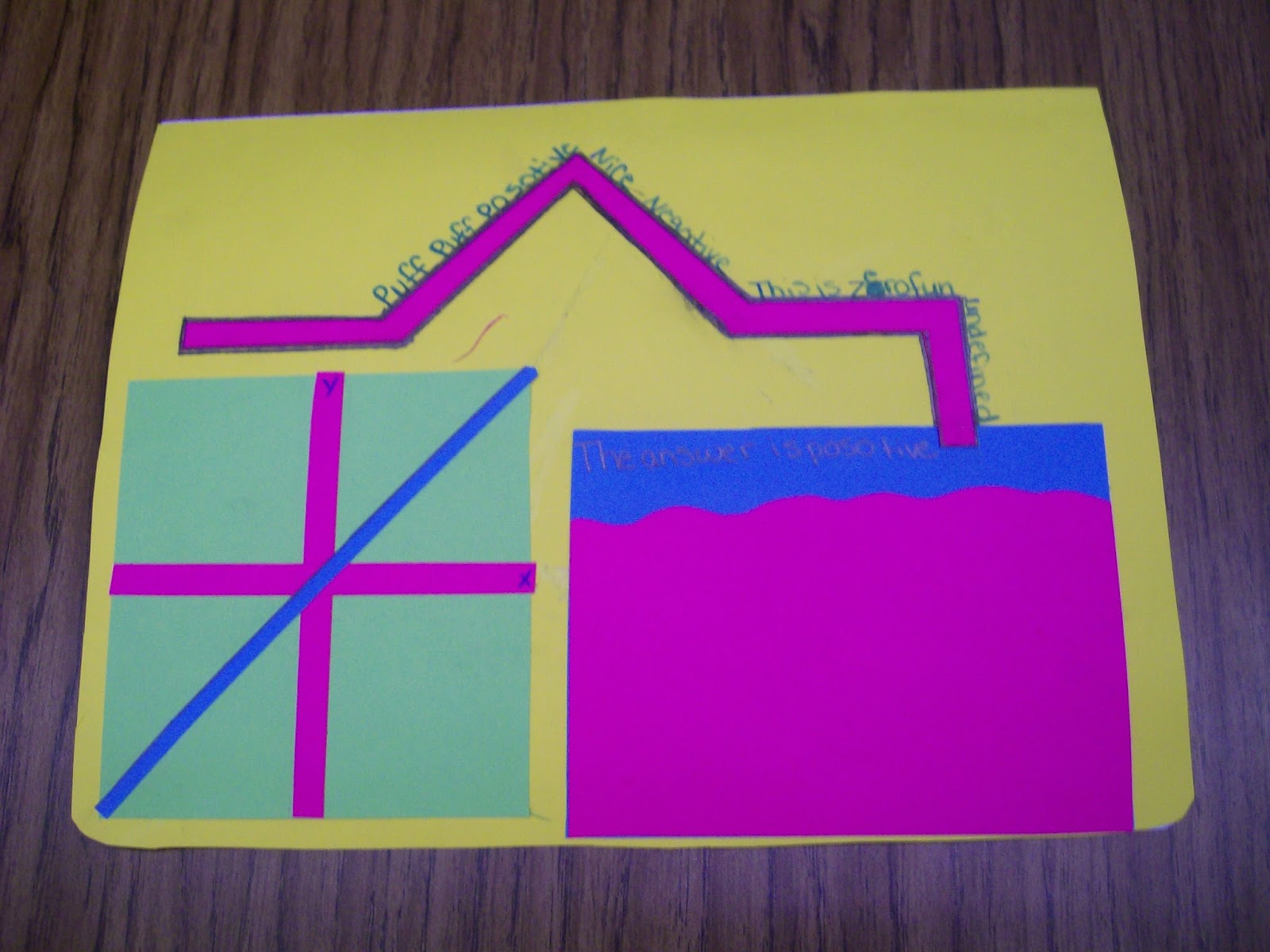
Four Types of Slope

Domain and Range


Four Types of Slope

Solving Systems of Equations by Substitution

Solving Systems of Equations by Substitution - Inside

Solving Systems of Equations by Substitution - Inside

Solving Systems of Equations by Substitution - Inside

Solving Systems of Equations by Substitution - Inside

Absolute Value Foldable with Slider

Absolute Value Foldable with Slider

Absolute Value Foldable with Slider

Parallel, Perpendicular, or Neither Foldable

Parallel Lines and Perpendicular Lines

Lines That Are Neither Parallel Nor Perpendicular


Mean, Median, Mode, and Range Foldable

Mean, Median, Mode, and Range Foldable

Domain and Range Graphic Organizer


Graphing Inequalities Foldable

Graphing Inequalities Foldable

Four Types of Slope Foldable

Domain and Range Foldable

Domain and Range Foldable - Inside
  
Older Post ►
 

Copyright 2011 Math equal LOVE is proudly powered by blogger.com