Showing posts with label algebra. Show all posts

Trying out "I Have...Who Has?" for the First Time

Do you know those ideas you see online that sound really, really good, but you never seem to get around to trying them out in your classroom?  Yesterday, I tried one of those out.  I Have...Who Has?  You know, the deck of cards where each card answers a previous card, and it makes a giant circle around the classroom if nobody messes up.


My Algebra 1 students are currently working on translating algebraic expressions and equations.  This is generally something I start the year off with, but I was super keen to start this year off with functions and graphing.  As a result, this topic got pushed back to the end of the year.

With snow days, should-have-been snow days, should-have-been school days, and days where half the school is gone to the basketball tournament, it seems like I've been having trouble making much progress with my students these past couple of weeks.  Due to the basketball tournament, I was only able to teach my morning classes yesterday.  These kids, knowing that they wouldn't be in school that afternoon, were not exactly in a mood to take notes and start a new topic.  I wasn't about to waste a perfectly good morning for instruction, though.

Normally, I would try to fit all my notes for this topic into one fifty minute class period.  Instead, I decided to do half the notes and a practice activity that would get the kids thinking and working with hopefully minimal complaining.  I wish I could tell you that the I Have - Who Has? cards fit this bill perfectly.

For my first hour, they did exactly that.  Only a few kids had experience with this practice structure.  And, they were really gung ho about the activity from the start.  There was some initial confusion because they couldn't figure out why the answers on the cards did not match up.  They didn't realize that another student would have the answer to their question.  Once they realized this, it seemed to go really smoothly.  With this class, I have a number of kids who have not been successful at math before that seem to be almost impossible to engage.  These students will take notes, but any time we are doing practice problems, they are more often than not seen drawing funny pictures on their dry erase board or telling a joke to a neighbor.  Threatening that they will have to take this class again if they fail doesn't exactly work on students who are already taking Algebra 1 for the 2nd time.

There's something completely different about this activity than my typical practice structure of solving the problems on individual white boards.  The success of the activity depends on every single student participating.  Any time there would be a pause in the activity, students would start checking their neighbors cards to see if they had the correct answer.  Students had to be engaged.  Students had to be participating.  Students had to be paying attention.  I don't think I've ever seen my first hour as engaged in a practice activity as they were for I Have...Who Has?

After finishing the deck, they begged to play again.  Students begging to do math.  Yeah, I could get used to doing this!  Students were asking if we could do this for other topics because it really helped them.  They decided this would be the perfect way to review for the EOI.

So, as I began 3rd hour (my next Algebra 1 class), I was floating on cloud nine.  I had this amazing, engaging, proven-to-work activity to try with my students.  They hated it.  Hated it.  I'm thinking it has a lot to do with the make up of the class.  This class is full of much more self-motivated learners.  Most of these students want to do well.  They want to succeed.  And, to them, this game was silly.  It was boring.  It was pointless.  I know this because there was a running commentary throughout the activity of just how stupid this was.  I guess you can't win them all...  It still did the job and got some practice done.  And, honestly, this group of kids would likely have complained about any activity I had tried to get them to do.

The deck of I Have...Who Has? cards that I printed off the internet was way too simple for my students.  It didn't have many variations of words that could mean the different operations.  If I were to do this again, I would probably make my own deck that better reflected the words I needed my students to be able to understand.  Now that I know the activity is worthwhile, I will definitely be making my own custom decks in the future.  I'm kinda glad that the first time I did this activity featured a pretty simple deck, though, because it meant we could focus on exactly how the practice structure worked instead of getting caught up with how to solve more complex problems at the same time.

The deck I used can be downloaded for free from: http://www.mathwire.com/whohas/whalgA.pdf

Rolling Dice for Point Slope Form and Desmos Awesomeness

This year I did something wrong.  Something seriously wrong.

What did I do wrong?  I'm not entirely sure.  But, my students are convinced that point-slope form is easier than slope intercept form.  This. Has. Never. Happened. Before.  My students normally dread point-slope form.  They cry.  They whine.  They threaten to drop out of school because algebra is too hard.  The week or so that we spend actively engaged in working with point-slope form is not a happy week.  At least it wasn't until this year.

So, what was different?  I can think of two things.

Giant Foam Dice and Desmos.


Instead of giving my students problems, I let them create their own problems.  Or, I guess I should say the dice created their problems for them.  First, students worked together in pairs of two.  Each pair got a giant foam die.  My math teacher coworker across the hall gave me these right before school started.  They are SO handy!

Decide before you start how to determine which numbers will be positive and which will be negative.  We decided to make odd numbers negative and even numbers positive.  This worked okay.  It led to a lot more horizontal and vertical lines than if you flipped a coin to determine positive/negative.  But, I think I'm okay with that.  Usually, I neglect to give my students enough practice with problems where the points form a line with zero or undefined (or Undefiiiiiiiiiinnnnneeeeddd! as Slope Dude would say) slope.

Roll the die twice to form the first ordered pair.  Roll the die two more times to form the second ordered pair.  At this point, students knew from their notes on point-slope form that they had to determine the slope of the line that went through these two points.  However, my students knew they had two options.  They could graph the two points and find the slope that way.  Or, they could use a table and their vertical number lines to find the slope.  (More about that here!)  Students could pick whichever way they felt more comfortable.  


It was so good to see kids using their notebooks.  It's a reminder that the notes we take in class really do make a difference.

Having found the slope, students plugged the slope and one of their points into the formula for point-slope form.  Then, we converted the equation to slope intercept form for even more practice with slope-intercept form.

This is where things take a radical turn from how I've done them in the past.  Usually, I would be like "Yay, we found the equation of the line.  Go us!  Let's do another one."  The problem with this is that my students aren't convinced that this equation actually goes through these points.  Assuming we've made no errors, I'm convinced.  But, then again, I'm an algebra teacher.  The thought of teaching equations is what makes me want to get out of bed in the morning.  My students?  Not so much.  


My students need to be convinced, though.  I could have them graph the two points and graph the line they found in slope intercept form.  But, knowing my students, they would probably just draw a line through the two points and "pretend" it matched the equation.  No, they need better proof.  Definitive proof.  And, that's what desmos provided us.

If my school had laptops, or ipads, or wifi access for students, I would let them each check their own work as they went.  But, sadly, that's not the type of school I work in.  We don't even have a computer lab that we can take students to.  I see the activities that other teachers are able to do with their students and desmos, and I get super jealous.  Extremely jealous.  Life goes on, though.  And, I remind myself that I am providing the best education for my students that I know how to with the resources I have been provided with.

Anyway.  Let's get back to how I was able to use desmos in my classroom.  I pulled up desmos on my desktop computer.  As pairs of students found the equations that went through their pairs of points, I had them bring their dry erase boards up to my desk.  I inserted the two points they had rolled with the dice into desmos.  Then, with great fanfare, I typed in the equation they had come up with.


One of two things happened.  Cheers because the line very clearly went through both points.  Or groans.  The students who cheered were sent back to their desks to repeat the process with newly rolled points.  The students who groaned were sent back to their desks to look for their mistake.

The feedback was instant and glorious.  Thank you Desmos!


And, there's just something different about the computer screen telling you you're right and your math teacher telling you you're right.

As the year has progressed, students still ask sometimes if we can "desmos" something when they want to check their work.  And, of course, I always say yes.  :)


Later on in the chapter, we were studying parallel and perpendicular lines.  We pulled out the dice again.  Roll the dice.  Form two points.  Find a line that is parallel to the line that goes through these two points.  Find a line that is perpendicular to the line that goes through these two points.  More desmos.  More awesomeness.  

Though, I guess we do need to work a bit on our spelling of parallel and perpendicular. ;)

Finding and Interpreting Slope INB Pages

This has been a weird year of teaching for me.  It's year three which means that I feel like I'm kinda starting to get the hang of this whole teaching thing.  But, at the same time, I see so many areas that I desperately need to improve in.  I go back and forth between feelings of excitement over being able to parts of lessons and notebook pages from previous years and feelings of disappointment in myself for just reusing things from previous years and not making them better.  My notebook pages this year look a lot like last year's with a few tweaks and new additions.

I haven't really done a great job of blogging notebook pages this year because it's seemed like I'd just be sharing the same stuff all over again.  But, I do need to make an effort to share these new pages with y'all.

Here are two new pages I created this year for Algebra 1's unit on slope.  


Last year, I let my students design their own notebook pages over finding slope from a graph.  While this let me see what they knew and understood, it did not lead to pretty notebook pages that they could later reference.  I knew this needed to be remedied this year!


I have posters in my classroom that say WWSDS?  This stands for "What would Slope Dude say?"  After students use rise/run to find the slope and write their answer, I ask them to consider WWSDS?  Then, they compare their answer to what Slope Dude would say.  If their answer was positive two thirds and Slope Dude would say "Nice Negative!" this is a sign of a problem.  I've blogged more about Slope Dude and these posters here. 


One of the standards for Algebra 1 in Oklahoma is that students are able to interpret the meaning of the slope and intercepts of a graph.  I feel like I've always sort of rushed over this before.  This year, I decided to spend an entire 50 minute class period just interpreting the slope of graphs and tables.

We took a few notes about interpreting slope.  Then, we got lots of practice in the form of a poof book!


Here's my notes over interpreting slope:


I gave students a sentence format to use to interpret slope.  For each example in the poof booklet, we used this sentence framework.  My students in the past have regularly fallen for the incorrect multiple choice option that leaves out the word change in the interpretation.  I was hoping that by having my students write this sentence a crazy amount of times that the word change would become ingrained in their memories!

Outside of Poof Book:


The inside pages of the poof booklet are tables and graphs that I stole directly from EOI sample problems provided by the Oklahoma State Department of Education.


So, I guess I should have put these two pages at the beginning of the post.  Oh well.  I think you can figure out what order these pages actually went in our notebook based on the content.  :)

The Slope graphic organizer was a reused page from last year.

However, the finding slope from a table or points notes are new.


I always start teaching slope with the "scary textbook definition."  Students are freaking out.  They think they're never going to understand this new topic.  Then, we slowly break apart the fancy definition into something that is much less scary and more familiar.  Eventually, they realize that slope really isn't that bad at all.


There are a lot of days where we just take plain old notes in my classroom.  Not everyday is filled with foldable fun.  Maybe someday...


I did find a way to incorporate a foldable into this lesson, though.  My students used our new handy dandy foldable vertical number lines to find the differences in the x values and the y values.  

We only do slope as delta y/delta x or change in y over change in x.  The slope formula (y2-y1)/(x2-x1) has been banned in my classroom for two years now.  And, it's one of the best decisions I ever made.  When my students have to think about what's happening on the number line, they are much more accurate and careful than when they try to remember integer rules that they never really learned in the first place.  
I'm also a total convert to vertical number lines now.  They're awesome.  Of course I still just have a horizontal number line in my classroom.  Next year, though, I will have a vertical number line on the wall, too.  It's a must-have now.  


I love that students can fold out the number line when they need it.  Fold it back when they don't. I wrote more about the vertical number line here.  


Want to download these pages?  Click here.


WWSDS: What Would Slope Dude Say?

One of my absolute favorite concepts in the world to teach is slope.  I don't know what it is about slope, but I have an absolute blast convincing students that slope doesn't have to be scary.  Plus, it involves introducing them to Slope Dude.  And, in my book, any lesson that makes the slightest mention of Slope Dude is a winner.

Hello, I am the person who has WWSDS signs hanging in her classroom.  Because you should obviously always ask yourself What Would Slope Dude Say?

Want to download these posters for your own classroom?  Click here!


I guess I should warn you about side effects of hanging these posters in your classroom, though.  I hung them up part way through our slope unit in Algebra 1 without comment.  I just waited for students to notice them.  They did.  They also started hypothesizing the meaning behind the letters.  In fact, all of my classes noticed them.  And, it was just too tempting for them to not try to guess what they must stand for.  The letters were just beckoning to them to figure their meaning out.  It makes me wish I could figure out more ways to harness my students' curiosity like this.  

My first period class decided they must mean "What Would Satan Do Seriously?"  This led to numerous (very untrue!) rumors about my being a worshiper of Satan.  Yeah...

Moving on...

During my first year of teaching, I assigned my students to draw a picture and label the different types of slope in the picture.  Then, last year, I changed things up and had them label the different types of slope that could be found in their name.  I liked this activity, but I missed the creativity that the previous activity had allowed.

This year, I decided to do the slope name art as our notebook entry and use the picture drawing assignment as the quiz.  Definitely the best of both worlds.

We did this lesson months ago, but I'm just now getting around to uploading pictures and sharing them.  As you scroll through my students' creations, you will realize that some of them put much more effort into the assignment than others.


A Prime Opportunity to Make a New Poster...

In case you were wondering, pun definitely intended.

I have so many ideas of how I would teach things/do things if life was ideal. And, by ideal, I mean I could pause time occasionally and get 100% caught up with my to do list.  I'm pretty sure I have no idea what it feels like to be caught up with one's list of things to do.  I still have things on my to do list that I put on there when I moved to Drumright in July of 2012.  It's now October of 2014.  I guess subscribing to the local newspaper isn't at the top of my list of priorities...

When I teach simplifying radicals, I teach my students to find the prime factorization of their radicand first.  Prime factorization is something that they should come to my classroom knowing, but I've found that many of my students need a short refresher course on prime and composite numbers.  I usually accomplish this by having my students classify the numbers between 1 and 100 as prime, composite, or neither.  We make a little chart to keep in our interactive notebooks.

 
When students are working on finding the prime factorization, I encourage them to keep their notebooks out and open to this page.  However, you know how that goes.  Students soon get where they just start assuming that a random number is prime instead of checking their chart.

Three years ago, I had this idea that I was going to make posters of the prime numbers to hang on the wall.  It never happened.  I taught radicals again.  And, again, I vowed to make posters.  At one point, I cut colored paper and assigned each student a prime number.  They were to decorate their paper with their prime number.  Then, I would laminate them and hang them up.  Silly me didn't think to specify to students how to orient their papers before writing on them.  Oops...

This year, I decided I was going to make this prime number poster thing happen.  But, I had a sort of dilemma.  The walls of my classroom are literally covered in posters.  Where could I hang the prime numbers?  Eventually, I decided that I had yet to utilize a small 4 inch gap between the bulletin board and the edge of the wall.  


I made a quick template in Microsoft Publisher that was 3 inches wide.  It didn't take long to duplicate the page and type in the prime numbers in a cute font.  This was made and printed in 7 minutes tops.  I gave one of my student aides the job of printing it on card stock, laminating it, cutting it out, and taping it to the wall.


The verdict?  Success.  Students are actually using the poster while working on their assignments or quizzes!  And, this makes this math teacher oh so happy.  

Want to download the files to print your own prime number banner poster?  Click here.

Solving Quadratics by Factoring and the Zero-Product Property

Ugh...I'm still finding random interactive notebook pages from last year that I never blogged about.  This is part of the reason that I'm trying to force myself to blog my notebook pages this year as entire units.

Here is Solving Quadratic Equations by Factoring.  I typed up the Zero-Product Property for students to cut out and glue in their notebooks.  In the future, I'd probably type up the steps as well to save time.  I might make them fill in the blank or something similar...


Download all of my files for teaching quadratics here.

Quadratic Formula Interactive Notebook Page

Well, since I posted my very own quadratic formula song yesterday, I guess it's only fitting that I post the rest of my quadratic formula stuff from last year on my blog.  This post has been setting in my drafts folder since Pi Day.  I obviously need to blog more often...  

My first goal was to get kids to memorize the quadratic formula.  I know from reading a lot of other math teacher blogs that many states provide students with the quadratic formula on a formula sheet on their state standardized tests.  Oklahoma is not one of those states  If they want students to specifically use the quadratic formula on a certain problem, they may provide it in a box next to the problem.  But, what if my students want to use the formula at other times?  If they don't have it memorized, then it can't be a tool in their tool box.  

Inspired by Journal Wizard, I decided to make a tangram puzzle with the quadratic formula written on it.  I've uploaded a template for the tangram puzzle below, but if you want to use this, you will have to write the quadratic formula on it yourself and cut apart the pieces to scramble the puzzle.  This was one of those interactive notebook pages that was thrown together 7 minutes before first hour started.  I tend to have a lot of these...  

Give the kids the scrambled tangram pieces.  Let them cut it out and assemble the puzzle.  Glue in your notebook.  


We've already talked about solving by factoring and solving by square rooting.  But, both of these required our equation to be just right in order to use the method.  The great thing about the quadratic formula is that it ALWAYS works.  

After gluing in the formula, we did an example to keep in our notebooks.  


Honestly, though, most of the first day we spent on the quadratic formula was focused on memorizing it.  It didn't help that 50% of my Algebra 2 classes were gone on this day either...

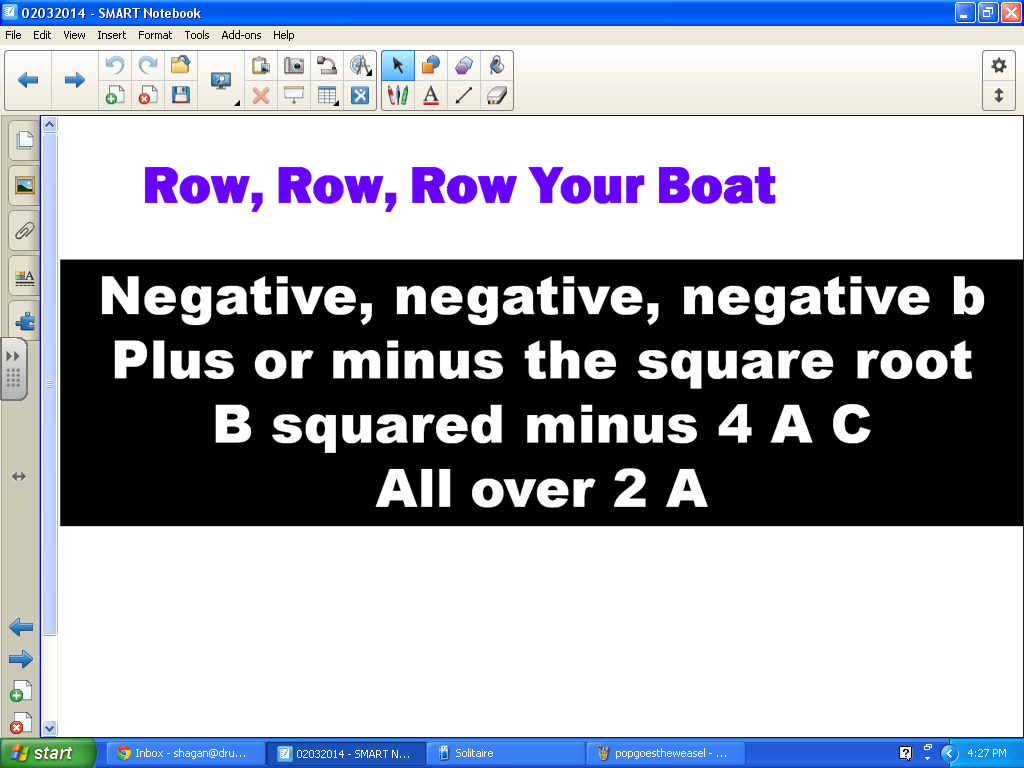
Emily shared several versions of the quadratic formula song with me.  I already knew the Pop Goes the Weasel version from high school.  The other two versions gave me and my kids trouble.  You never know until you try, though.


We also watched two versions of the quadratic formula on Youtube: Adele and One Direction.

I'd read about a teacher having their students sing/recite the quadratic formula to another teacher as an assignment before, and I decided I had to try it.

Here's the very official looking form I made up:


To make sure that students could recite the formula to anyone, I wrote out the formula both in "math" and in "English."  We only have 12 teachers in our high school, so I was afraid that they were going to get mad at me/frustrated with hearing the song from the 36 or so Algebra 2 students I had last year.  But, I'm not sure a single teacher ever actually mentioned the assignment to me.  Hmmm...

There are several possibilities here.
1.  My students never actually recited the formula or sang the song for their teachers.  Instead, they forged their signatures.

2.  The teachers thought it was a perfectly normal assignment and felt no need to comment on it.

3.  The teachers thought this was a crazy assignment, but they also think of me as a teacher with crazy ideas.  So, this came as no surprise to them.

Hmmm...

Pop Goes The Weasel ended up being the most popular way, by far, to memorize the formula.  My Algebra 2 classes quickly fell in love with the song.  And, they would break out into song quite often.  Anytime I would write the quadratic formula on the board, I would sing the lyrics as I wrote them.  My students started doing the same.

Last year, I did a great job of getting kids to memorize the formula.  I did a much worse of getting them to use it properly.  Positive and negatives ended up tripping them up way too much.  Plus, they all preferred to solve their quadratics by graphing when given the choice...  This is on my list of things to improve upon for this current school year.

Download files for the tangram and the quadratic formula memorization/recitation assignment here.  
Older Post ►
 

Copyright 2011 Math equal LOVE is proudly powered by blogger.com