Showing posts with label Statistics. Show all posts

Free Greek Alphabet Banner Poster

Hey guys!  Happy Monday!


I'm back from vacation.  It was a fun whirlwind, but I'll tell you more about that later.  Before I take the time to reflect on my trip, I want to post some goodies to share with you.  In 37 days, my room will be filled with kiddos.  This means it's time to get serious about getting my classroom decorated.  My students are always amazed when I take down all my decorations at the end of the school year.  They complain that my room is "naked" and should be charged with "indecent exposure."  After seeing colorful walls for 180ish days, they couldn't stand empty walls.  They would walk in my classroom and freeze, sensing something was wrong.  But, I see it as a blank canvas.  A chance to change things up for the new year.  Potential.  And, I'm definitely going to change up things in my classroom this year.  I've been busy, busy, busy making new posters and signs.  And, I can't wait to share them with you!


Last year was my first year to teach statistics.  I learned a lot.  One of the things my students struggled with was working with Greek letters for the first time.What's sigma look like again?  What's that funny looking u thing you drew on the board?  Why can't we use the regular alphabet?  One day while looking up the Greek alphabet for my struggling students, I learned for the first time that there are upper case and lower case Greek letters.  How did I not know that before?

Free Greek Alphabet Poster Download

This year, I won't be teaching statistics, but I'll be teaching trig/pre-calculus instead.  We might not use quite as many Greek letters, but I wanted to create a reference place in my classroom for the Greek alphabet.  I will definitely reference theta with my trig students and delta with my algebra students.  I couldn't find anything I liked online, so I made my own.  These are meant to be printed, cut along the lines, and hung up as a banner poster.  Picture putting together one of those handwriting banners.  Though, I guess you could do all kinds of different things with them.

Here are images of the individual pages in the PDF file.  The PDF file (and an editable Open Office file) are embedded at the bottom of this post.  If you have trouble downloading the files, send me an e-mail at mathequalslove(at)gmail(dot)com.  

Once I get these printed, laminated, and hung in my classroom, I'll update this post with a picture of these posters in action.  Hope someone else will find these posters to be useful!

Poster Beginning Title

Alpha - Delta

Epsilon - Theta

Iota - Mu

Nu - Pi

Rho - Upsilon

Phi - Omega

Embedded files to download your own set of posters:


What's On My Classroom Walls

So, we're supposed to write a blog post about what's on the walls of our classrooms.  And when someone tells me to do something, I usually do it.  Except when I don't.  Like when Kate asked us to post about why we blog.  I meant to do that, but I never got around to it.  Sorry Kate!  And, I never did my Day In The Life post either.  I wrote down everything I did for a day, but I'm pretty sure those notes are long gone...  Or, back circa 2009, I got tagged in one of those 25 Random Things About Me posts on facebook.  I was supposed to write my own list of random things.  I put it on my to do list, but it's 2014 and still undone.  Oops...  Maybe I should write a list of random things about myself to put on my About Me page.  Adding to my to do list right now.  Maybe it'll get done within the decade.  :)      

Seeing as my summer has already started, my decorations are all taken down for the summer.  I know some of you are still in school.  Don't hate me!  I counted today, and I have 86 days left until school starts back up again on August 14th.  And, I have so, so, so much to get done before then!

Classroom Decorations In Preparation To Be Packed Away


Though my decorations have been packed away, I did manage to find photos of most of my wall decorations to share.

The northwest corner of my classroom had two posters - Nelson Mandela and an aerial shot of a field that was cut/plowed/I don't know what you call it to look like a vase of flowers.  I picked up the aerial photograph poster at a garage sale for a quarter.  The Nelson Mandela Poster was in a set of three free posters that I received from The Foundation For A Better Life.  You can request your own set of three free posters and a dvd here.  

Posters in NW Corner of Classroom

On my cabinet, I posted Truth Signs and various mathematical posters that I printed off the Internet.  You can download the Truth Signs here.  

Posters on Storage Cabinet

Along the top of my dry erase board, I posted the 8 Standards of Mathematical Practice in kid-friendly language.  I downloaded these from Everybody Is A Genius.  Above those are posters I downloaded from NCCTM.  

Posters on Dry Erase Board

This year, I made one of my bulletin boards into a wall of pride.  I wanted to create a place for students to post things they were proud of.  I guess I didn't do a very good job of explaining this because hardly anything got hung up there all year.  It soon became more of a place to hang lunch menus and fliers.  I did hang up a few things that students colored or made for me.  And, during the last month of school, I did have a student make a snowflake and hang it up on the wall of pride.  Yes, a snowflake in May.

I also have two flags in my classroom from my alma mater, The University of Tulsa!  Go Golden Hurricane!

Wall of Pride Bulletin Board

Snowflake

One of the first things students look at when they walk in my classroom is the daily and monthly celebrations that are posted below the date.  I look up the crazy holiday celebrations here.  The date is always written as a math problem.  This drives my students insane.  Some will ask me the date in an effort to get out of solving the problem on the board.  When they do this, I will read the problem directly off the board in response to their question.

Date and Daily Celebration on Dry Erase Board

Below the date and holidays, I post a quote of the week.  These consist of posters I have downloaded off the Internet and posters of math quotes I have created myself.  You can download the posters I created here.

Quote of the Week


One of my bulletin boards is rather unfortunately placed behind two lovely pipes.  It's certainly not ideal, but you have to learn to live with things like this when you teach in a building that's been around since 1919.  This was a new addition for this year.  Students earn their name on a star by scoring at least an 85% on a unit test.  Since I've started dipping my toes into the waters of SBG, I'm not sure how to modify this or if I should even continue this.  My students loved it.  They love seeing their names up on the board.  My students from my first year of teaching were really mad at me for introducing this because they never got to have their name up on a star when they were in my class.

Star Students Bulletin Board

Above my SMART Board, I have a banner that reads, "Welcome to Class."  I picked it up at Wal-Mart in their $0.88 bin two years ago.  This past year, I added left/right posters.  I was shocked at how many of my high school students have trouble differentiating between left and right.  Next year, I want to add cardinal direction posters as well.  Our school likes to make announcements such as, "There will be a senior picture at 11:30 on the south steps."


Welcome to Class!  (And, Left and Right Reminders)

This year I took one of my bulletin boards and used it to post some free Texas Instrument calculator posters that I received at a workshop.  Since my district doesn't have TI Smart View, and I can't use my Smart Board and my document camera at the same time, these come in handy to show students where various calculator buttons are.    
Calculator Posters


As the year progressed, I added friendly reminders for frequently used calculator buttons.  

Adding Helpful Reminders to Calculator Posters

Behind my desk, I have several free posters that I received from the AMS.  You can request free posters here.
Math Posters Behind Desk

I also have a Mona Lisa poster behind my desk with a reminder to smile.  Somedays, I really need this reminder!

Mona Lisa Poster

At the back of my room, I have a bulletin board that I planned on changing out monthly.  Well, I put up Pascal's Triangle in August, and I took it down in May.  So, that plan failed.  Maybe next year...

Pascal's Triangle Bulletin Board

One of the best things I hung up in my classroom this year was a number line.  It was a great help to me in my teaching and my students while they were working.  For example, I taught slope as change in y over change in x.  If the y value began as 3 and ended as -5, students could locate 3 and -5 on the number line and visually see that there was a decrease of 8.  My students do not come to me in Algebra 1 with strong integer skills, so this number line is a lifesaver.  My students have requested that I make them individual number lines next year to keep in their notebooks.  My special education students especially need this because there is no number line available to them if they go and work in the resource room.  Though, I guess I could print off another copy of the number line and gift it to our special education teacher.  I may just do that!  If you want to print your own number line poster, I wrote a post about it here.

Printable Number Line Pieces 

Here's my number line up in action.  With more free posters above it.  Can you tell I love free posters?  :)

South Wall of Classroom with Number Line

On my door is one of my favorite classroom decorations.  I found this on pinterest, and I modified it to be about math instead of science.  I have posted the file to make this here.

Door Decoration

Below my SMART Board, I have various problem solving strategy posters displayed.  I didn't emphasize these as much as I should have this year.  Problem solving strategies are going to be a major area of emphasis for me next year with the transition to Common Core, though.  You can download these problem solving strategy posters here.

Problem Solving Strategy Posters Below Smart Board

Outside my classroom door, my parents built me a bulletin board to hang stuff on.  They also built all the other bulletin boards in my classroom.  Let's just say my parents are super crafty, do-it-yourself people!  Here, I post my name, room number, and subject taught.  I also added math comics and a poster I picked up at Target, I think.

Bulletin Board Outside Classroom Door

These posters are hung up on a wall that I amazingly never photographed in my classroom.  I got them for free from WeUseMath.org.

More Free Math Posters

Hanging from my ceiling, I have modular origami made from sonobe units.  By the end of the year, my students are always very excited to finally learn how to build their own origami projects.

Origami Hanging From Ceiling

I try to display student work to inspire other students, but I haven't done the best job of it.  This was one of my student's projects during my first year of teaching.  My students this year loved looking at it and using the handles to make the reporter move.  When students would ask where the pencil sharpener was, I would always explain that it was by the television.  "But, but, but there's not television in here!"

Student Projects On Display

My aim is to have a classroom decor that is bright, colorful, inviting, and inspiring.  My students notice what is on the walls.  They see things and ask questions.  Creating a beautiful classroom environment is just one way I can show my students how much I care.  Our students come to use from a middle school that is less than five years old.  When they come to our almost hundred year old building, the difference is evident.  By taking the time to make my classroom a home of sorts, I am communicating the effort I am willing to put out and the effort I expect my students to put out.  Plus, I spend 8-12 hours a day in this room.  It needs to be a place that makes me smile!

View of Classroom From My Desk

Over the course of the year, my students add their own touches to the decor.  They love to draw pictures on the dry erase boards and post them for the other classes to see.  Here are a few pictures of boards that have found a home in my classroom this year.  I usually leave them up for a few weeks before erasing them.  My students always get mad when I erase them, but if I didn't, we wouldn't have any boards left to solve problems on!

Student Artwork

Student Artwork

Student Artwork

Student Artwork

Since my classroom is small and has less wall space than I would like, I have also taken to hanging things on the wall outside my classroom.  Here are some posters that my students made to review the process of factoring polynomials.

Factoring Difference of Squares Poster

Factoring Difference of Squares Poster

I also hung up my statistics semester projects on the wall outside my classroom.

Statistics Poster Project

Statistics Poster Project

Statistics Poster Project

So, there you have it.  This is what adorned the walls of my classroom this year.  Could it be better?  Of course!  I'm already working on plans for next year's classroom decor.  I've bought some new posters.  I also picked up the cursive alphabet to hang up.  Hardly any of my students can write in cursive.  It's becoming a scary world out there!  I'm also thinking about posting the greek alphabet.  That would have come in super handy in statistics this past year.  But, I figure we can find a way to use it in trig next year, too.

Normal Distribution Cards

Several months ago, my statistics students were struggling A LOT with normal distribution.  Our textbook just didn't have enough practice problems.  And, they clearly needed more practice before moving on to the next section!

A quick google search led me to my friend's blog.  In retrospect, I should have just gone there first.  When it comes to teaching stats, @druinok is the best!

I quickly downloaded her Normal Distribution Cards and printed then on colored paper.  The cards are printed so one side has a question, and the other side has the answer to a different card.

Normal Distribution Cards In Action

Students begin by laying out all the cards with the answers facing up.  They pick any card to start with that they want to.  As a group, they used their calculators, dry erase boards, and normal distribution tables to solve the problem.  If the answer isn't on one of the other cards, they have done something wrong!

Once they find the card with the correct answer, they turn it over.  This is their new question to solve.  Once again, they have an answer bank to choose from upon finishing.


At first, my students were super frustrated.  These questions are hard!  Why does there have to be so many questions?  We're never going to finish!

But, with each question that they finished successfully, their confidence grew!  By the end of the fifty minute class period, they were laughing and enjoying themselves.  They all commented on how the class period had flown by.  And, these types of questions weren't that hard after all.

This was a new practice structure to me, and I want to modify it to use it for my algebra and trig classes next year.  #SummerToDoList

Statistics: Confidence Interval Projects

This year, I had the privilege to teach a non-AP statistics class for high school juniors and seniors who had finished Algebra 2 and were not enrolled in upper level math courses through our local technology center.  As a small high school, our math department offers 10 sections of math: 4 sections of Algebra 1, 3 sections of Geometry, 2 sections of Algebra 2, and 1 section of an advanced math elective.  Last year, the elective was College Algebra.  This year, it is Statistics.  Next year, it will be Trig/Pre-Calculus.  Our local technology center offers Pre-Calculus and AP-Calculus since many of the schools in our area are too small to offer those classes.

I had 5 juniors enrolled in my statistics class this year.  As one of our end-of-year projects, I asked students to ask a question about the population of students (168 students) at Drumright High School.  After getting their questions approved, students had to randomly select 35 students using the random number generator on their calculator and a list of all the students in the school that our school secretary kindly printed off for us.  Next, they found a way to find out how that student would answer their question.

Proof that we are a small school: my students did not have to actually come in contact with all of the students they randomly selected.  For example, one student wanted to know what proportion of DHS students play school-sponsored sports.  After doing his random selection, he could look at the list and instantly know which students were and were not enrolled in athletics.  For those students he was unfamiliar with, a quick question to the rest of the class gave him the information he needed.

The collected data was used to find their p-hat value.  I asked them to make sure the conditions were met to form a confidence interval.  And, I dictated that we would be finding a 95% confidence interval.  If the conditions were met, their task was to find the confidence interval and express their results on a mini-poster.  These posters contain only a summary of their work.  They showed all of their work in detail using the EMCCC model on a separate sheet of notebook paper.

I loved seeing how invested the students were in their projects.  It was great to see them come up with their own questions, generate their own random samples, survey the students, perform the necessary calculations and analysis, and summarize their findings.

This has been my first time ever teaching statistics, so there are definitely a lot of things I would like to change in the future.  But, I'm so glad I got the chance to teach this course this year.  It's been awesome to be able to expose my students to a new field of mathematics!    

Four out of my five students completed the project.  Here are their questions and findings:

What percent of DHS students own an iphone?


What is the proportion of DHS students that have at least one full sibling?


What proportion of DHS students participate in school athletics? 


What percent of DHS students plan on attending college in the near future? 

This one is hard to read because the information was written so small.  

You can be 95% confident that the actual proportion of Drumright students planning to attend college is somewhere between 0.5132 and 0.8268.


Time-Saving Tips

The more I teach, the more I look for time savers.  There is just not enough time in the day to do everything I want to.  So, any time saving measure I can implement allows me more time to get my work done and still try to have a life outside of school.

Occasionally, I will admit to my students that I didn't grade their quizzes or homework or something else that they expected me to do.  I usually apologize and try to make it into a joke.  "Sorry, but you know I like to have a life sometimes, too."  They usually follow this up with something like this: "Oh, did you go clubbing last night?"  "Uh...no.  Actually, I was asleep before 9 pm."  I guess my definition of having a life and theirs varies greatly.

So, here are some ways that I try to save myself and my students time.

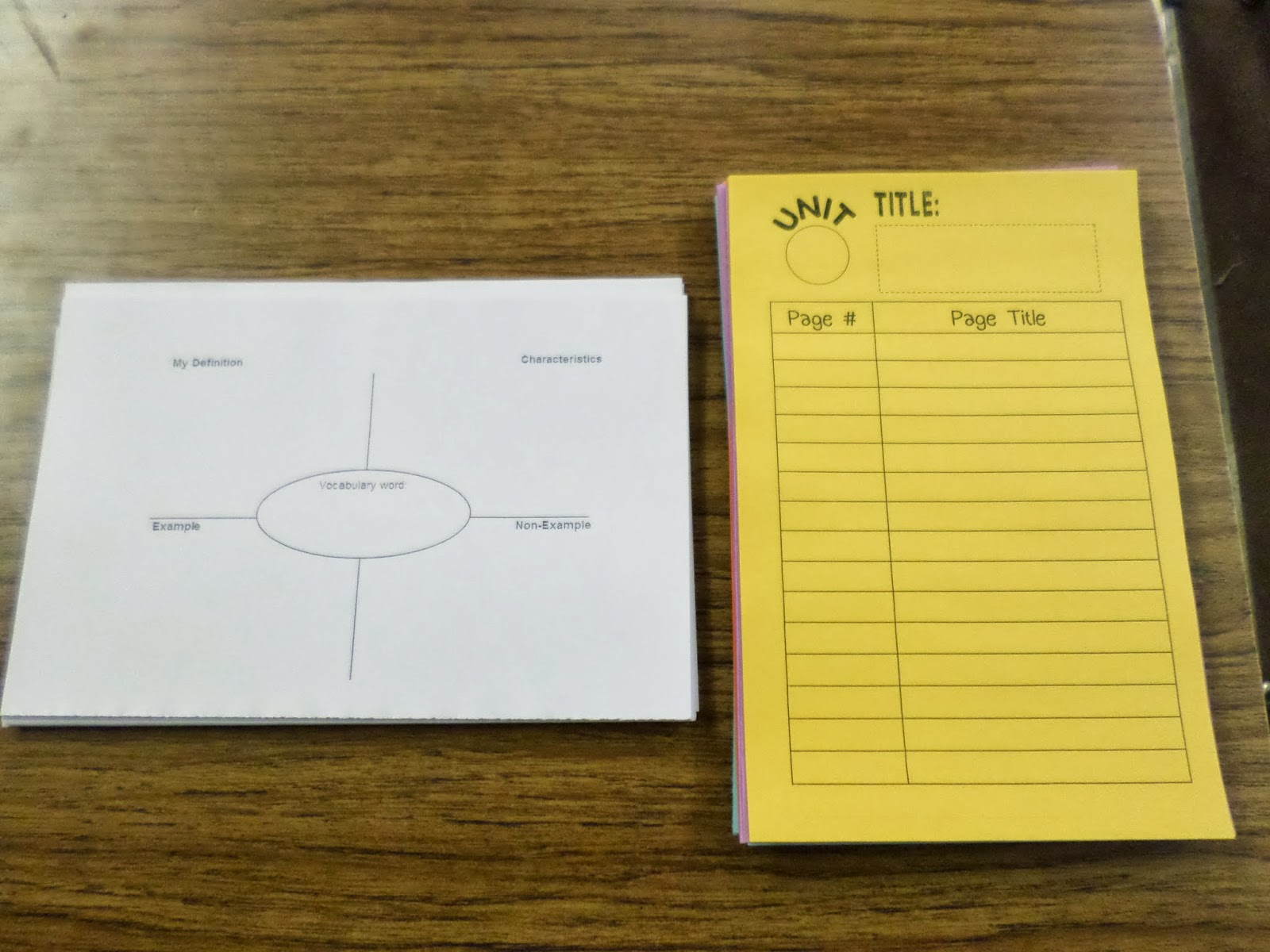
Make copies of frequently used interactive notebook forms.  It's no secret that I love the Frayer Model for Vocabulary.  I usually print 50-100 of these at a time and chop them in half.  I keep them in a file folder labeled "Frayer Model."  Whenever I want to use a Frayer Model with my students, I just pull out the file, and I'm ready to go without having to make copies.

I also run off our Unit Table of Contents pages in bulk.  We put one of these table of contents forms at the beginning of every unit in our interactive notebooks.  I also print 50-100 of these at a time and chop them in half.  They are kept in a file folder labeled "Table of Contents."  I always know where they are at, and it's nice to not have to make copies every time we go to put one of these in our notebooks!

Frayer Model / Table of Contents Form
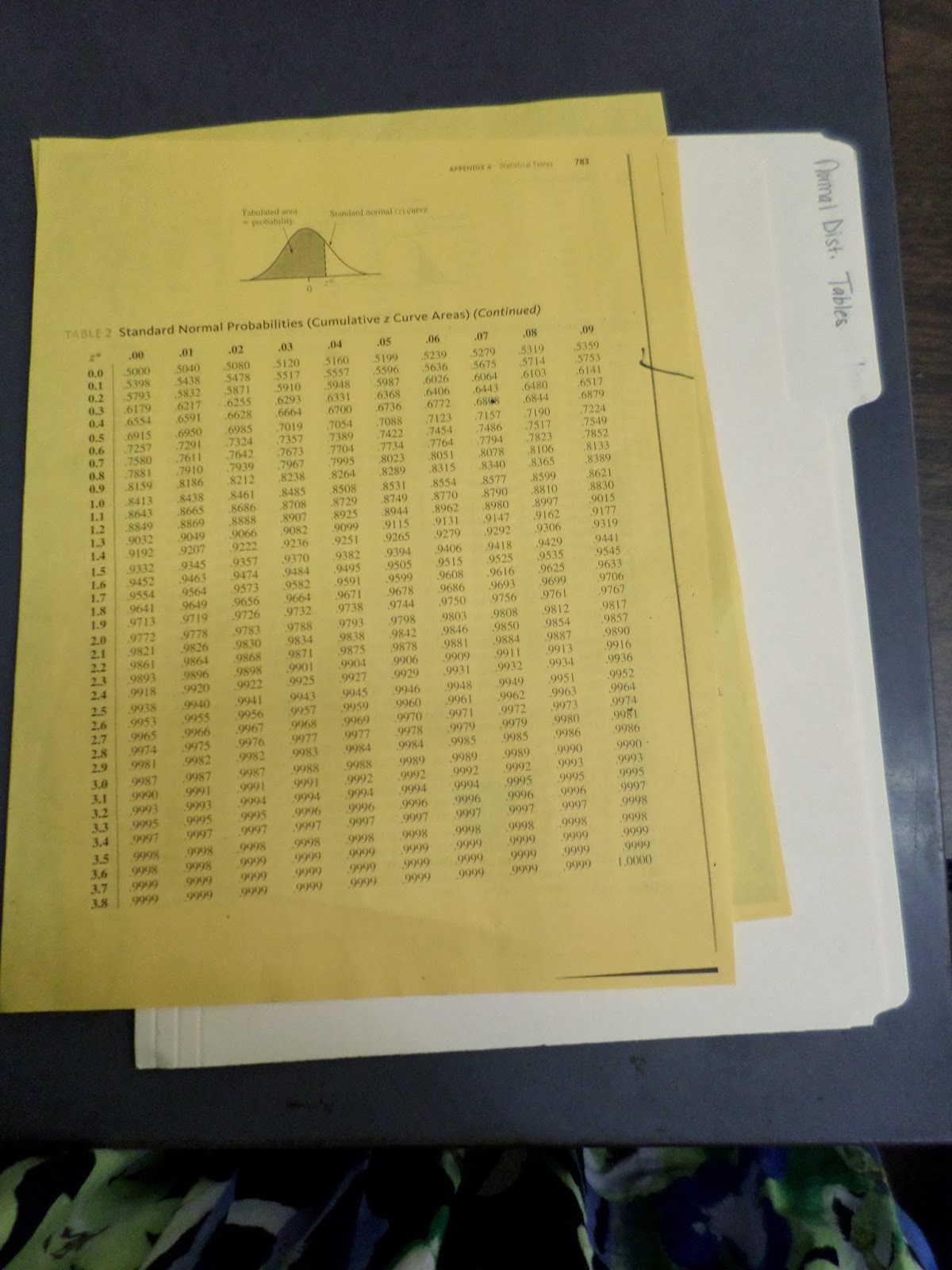
Make copies of frequently used tables/reference sheets on colored paper.  The next idea is something that probably saves my students more time than it does me.  In Statistics, we are working with the Normal Distribution Model.  Our textbook has tables in the back, but they are kind of inconvenient to use and find.  Students quickly tire of flipping back and forth, back and forth, back and forth.  So, I ran off copies of these tables, double-sided, on colored paper.  I keep them in a folder at my desk.  Whenever we are working on problems that require the use of these tables, I set out the folder.  Students grab a table from the folder and return it when they are done.  These have been a giant time saver!

Normal Distribution Tables
Laminate stuff so it lasts!  My Algebra 2 students and I LOVE conic cards.  I will continue writing about conic cards until the entire world knows about their greatness!  :)  I've learned the hard way that simply printing activities on card stock is not enough if I want to reuse them the next year.  Laminating stuff and cutting them out is time consuming.  But, having to recreate the same activities year after year is also time consuming.  I've found it's better to take a little extra time and laminate stuff in the first place so I don't have to spend time the next year recreating it.  I also laminated the answer sheets to my conic cards.  The fact that they are laminated and color-coded makes it much easier for me to find my answer sheets.

Conic Card Answer Sheets
Keep Track of Future INB Changes In This Year's INB.  Recently, I had an epiphany in regards to interactive notebooks.  Every year's interactive notebooks are different.  I'm continually trying new strategies to engage my students.  From year-to-year, I keep the best pages and strategies from the previous year, and I try new things in an attempt to give my students the best education possible.  Sometimes, I have a brilliant idea AFTER we create a page.  Or, I find after teaching something for the third time that day, I decide that there has to be a better way to word something.

This summer, I picked up some light bulb post-it notes at Target in the Dollar Spot.  I've started marking things that I want to change or did change with a light bulb note.  This way, next year, I will be able to remember what did and did not work well with my students.

Light Bulb Notes - Reminders for Next Year
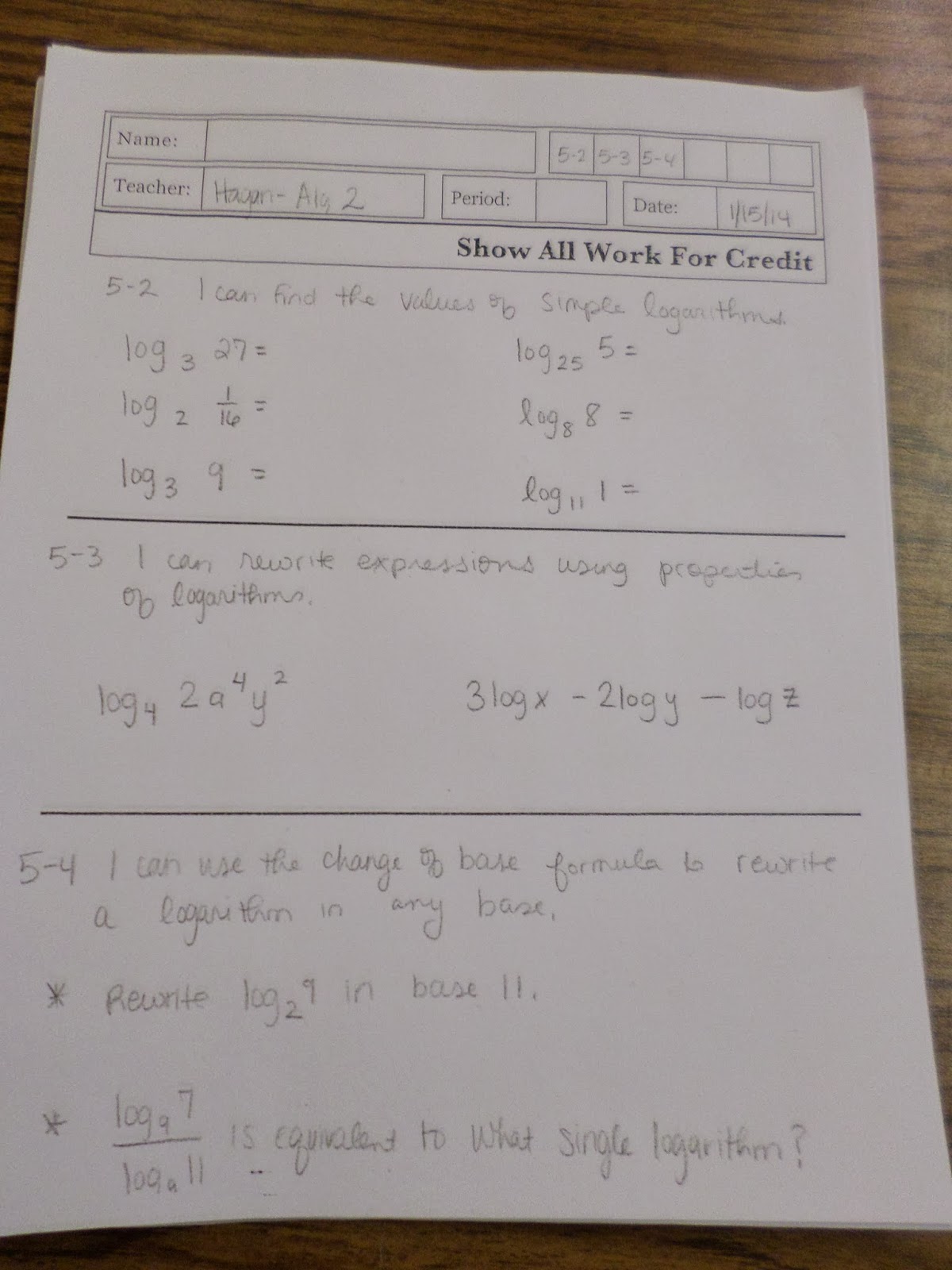
Make SBG Quizzes Easier to Write.  I haven't written about it a lot, but I'm kinda sorta trying out SBG with my Algebra 2 classes.  This means I've been writing more quizzes lately than I've ever written in my life.  Quizzes can be time-consuming things to write if I let them.  In college, I remember thinking poorly of professors for hand-writing their tests and quizzes.  For some reason, I thought that if they really cared, they would type everything.  Well, I'm coming around and seeing things differently.

I can hand write a quiz in about a third of the time that it takes to type a quiz.  Let's be real.  Equation editors are nice.  But, it takes forever to input all of the various equations needed for a quiz.  Recently, I decided to steal Dan Meyer's blank SBG test (at the bottom of his page before the comments) and use it to write my quizzes.  I've made 15 or so copies of this that I keep in a file.  When it is time to write a quiz, I pull out a blank copy, write my quiz, and make copies.

SBG Quiz Template
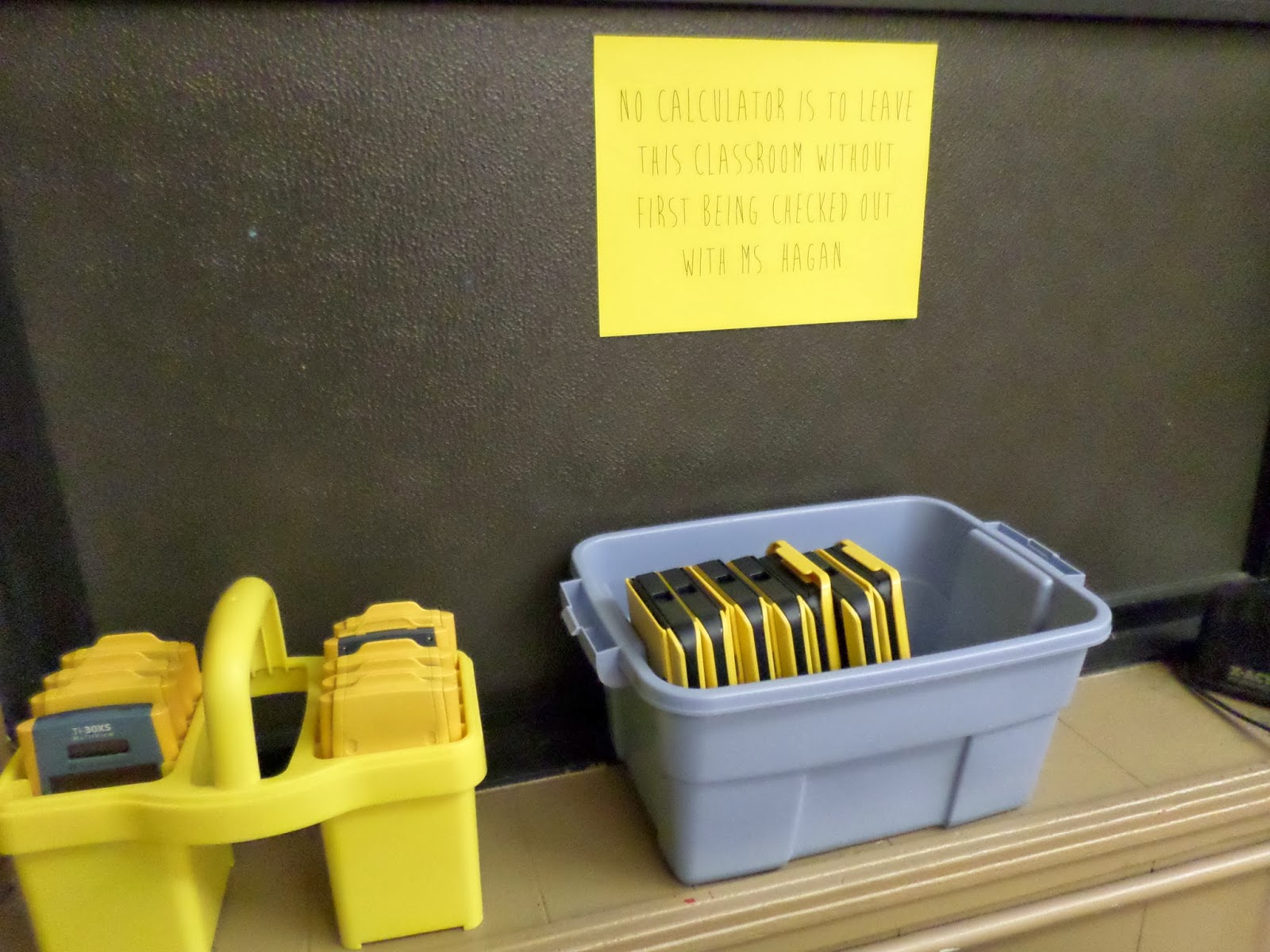
Split Up Calculators.  To save my students' time, I have recently placed my calculators in two different locations in my room.  This was actually a suggestion of one of my students.  Now, students who sit toward the front of the classroom can pick up a calculator from the front of the classroom.  Students who sit toward the back of the classroom can pick up a calculator from the back of the classroom.  I'd like to think that this also makes students more likely to put up their calculators when leaving the classroom.

Calculators At Back of Classroom

Calculators at Front of Classroom


What cool tips do you have to save time?  Share them in the comments!
Older Post ►
 

Copyright 2011 Math equal LOVE is proudly powered by blogger.com