Showing posts with label Quadratics. Show all posts

Solving Quadratics by Factoring and the Zero-Product Property

Ugh...I'm still finding random interactive notebook pages from last year that I never blogged about.  This is part of the reason that I'm trying to force myself to blog my notebook pages this year as entire units.

Here is Solving Quadratic Equations by Factoring.  I typed up the Zero-Product Property for students to cut out and glue in their notebooks.  In the future, I'd probably type up the steps as well to save time.  I might make them fill in the blank or something similar...


Download all of my files for teaching quadratics here.

Quadratic Formula Interactive Notebook Page

Well, since I posted my very own quadratic formula song yesterday, I guess it's only fitting that I post the rest of my quadratic formula stuff from last year on my blog.  This post has been setting in my drafts folder since Pi Day.  I obviously need to blog more often...  

My first goal was to get kids to memorize the quadratic formula.  I know from reading a lot of other math teacher blogs that many states provide students with the quadratic formula on a formula sheet on their state standardized tests.  Oklahoma is not one of those states  If they want students to specifically use the quadratic formula on a certain problem, they may provide it in a box next to the problem.  But, what if my students want to use the formula at other times?  If they don't have it memorized, then it can't be a tool in their tool box.  

Inspired by Journal Wizard, I decided to make a tangram puzzle with the quadratic formula written on it.  I've uploaded a template for the tangram puzzle below, but if you want to use this, you will have to write the quadratic formula on it yourself and cut apart the pieces to scramble the puzzle.  This was one of those interactive notebook pages that was thrown together 7 minutes before first hour started.  I tend to have a lot of these...  

Give the kids the scrambled tangram pieces.  Let them cut it out and assemble the puzzle.  Glue in your notebook.  


We've already talked about solving by factoring and solving by square rooting.  But, both of these required our equation to be just right in order to use the method.  The great thing about the quadratic formula is that it ALWAYS works.  

After gluing in the formula, we did an example to keep in our notebooks.  


Honestly, though, most of the first day we spent on the quadratic formula was focused on memorizing it.  It didn't help that 50% of my Algebra 2 classes were gone on this day either...

Emily shared several versions of the quadratic formula song with me.  I already knew the Pop Goes the Weasel version from high school.  The other two versions gave me and my kids trouble.  You never know until you try, though.


We also watched two versions of the quadratic formula on Youtube: Adele and One Direction.

I'd read about a teacher having their students sing/recite the quadratic formula to another teacher as an assignment before, and I decided I had to try it.

Here's the very official looking form I made up:


To make sure that students could recite the formula to anyone, I wrote out the formula both in "math" and in "English."  We only have 12 teachers in our high school, so I was afraid that they were going to get mad at me/frustrated with hearing the song from the 36 or so Algebra 2 students I had last year.  But, I'm not sure a single teacher ever actually mentioned the assignment to me.  Hmmm...

There are several possibilities here.
1.  My students never actually recited the formula or sang the song for their teachers.  Instead, they forged their signatures.

2.  The teachers thought it was a perfectly normal assignment and felt no need to comment on it.

3.  The teachers thought this was a crazy assignment, but they also think of me as a teacher with crazy ideas.  So, this came as no surprise to them.

Hmmm...

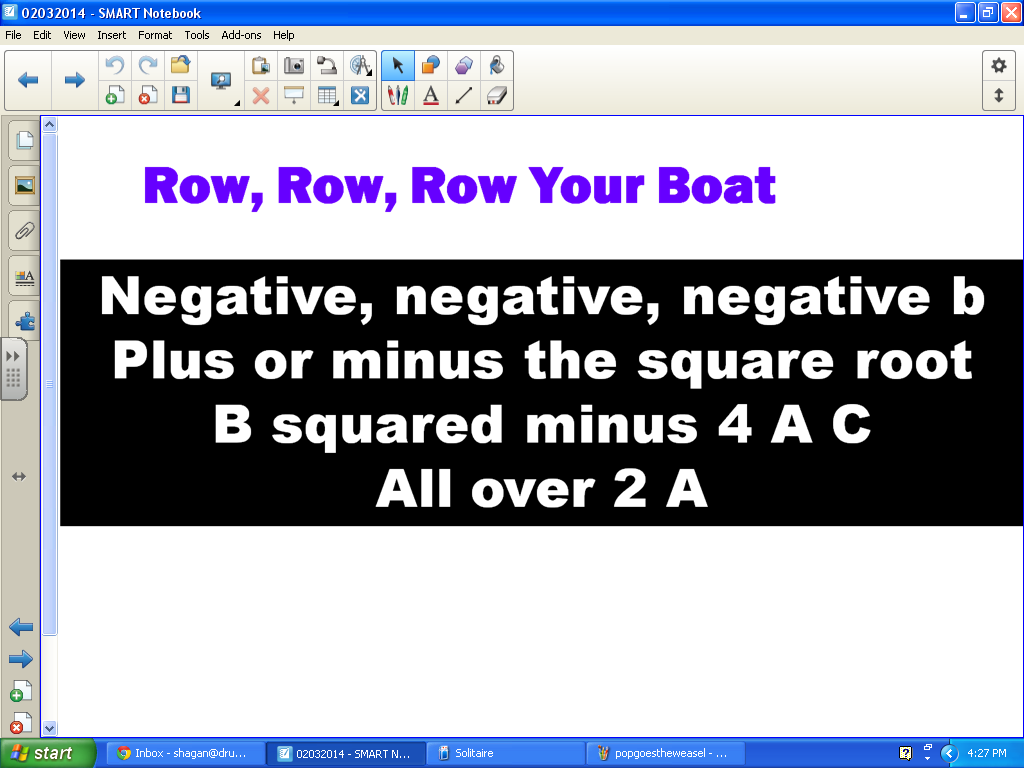
Pop Goes The Weasel ended up being the most popular way, by far, to memorize the formula.  My Algebra 2 classes quickly fell in love with the song.  And, they would break out into song quite often.  Anytime I would write the quadratic formula on the board, I would sing the lyrics as I wrote them.  My students started doing the same.

Last year, I did a great job of getting kids to memorize the formula.  I did a much worse of getting them to use it properly.  Positive and negatives ended up tripping them up way too much.  Plus, they all preferred to solve their quadratics by graphing when given the choice...  This is on my list of things to improve upon for this current school year.

Download files for the tangram and the quadratic formula memorization/recitation assignment here.  

Singing and Writing Math Songs

My Algebra 1 students are currently working on graphing linear equations.  There are a ton of great math songs/videos out there about this topic, and I've been showing to them to my students.  We've watched Graph Shop, Graph!, Rise Up Run Out, Slope Rida, and The Adventures of Slope Dude so far this year.  I also showed Gettin' Triggy Wit' It to my trig class.  My Algebra 2 students are soon going to feel left out because we haven't watched a video all year...    

One of my usually very quiet eighth graders raised her hand this past week and asked, "Why don't you make awesome math videos for us?"  Well................ummmmmmmmmmmmmmmm...........you see... it turns out I'm not the most creative person.  I tend to leave this job to the professionals.  And by "professionals," I clearly am referring to math teachers who are much cooler than me.  I know the fact that there are cooler math teachers than me in this world is hard to wrap your mind around, but please try.

My trig students have just started working with radians.  I wanted them to get a grasp of just what a radian is.  I know that when I took trigonometry in high school, I knew how to do a lot of trig, but I didn't quite know the "why" behind a lot of what we did.  I was the type of student who didn't ask questions.  If a teacher gave a rule or showed a procedure, I followed it.  Since I've started teaching, I've become a lot more curious about mathematics.  What is a radian?  Why does that shortcut work?  What is that little number perched by the radical sign called?  Why are they called conic sections?  I'm continually learning, and this is one of the reasons why I LOVE my job.

When I started researching just what a radian was, I found a great discovery activity that I'll blog about soon.  In one of the lessons I found, there was a song to help students remember the circumference of a circle.  The students at my school have a tough time memorizing formulas.  I'm not sure if that is a universal trait or if our students are just especially bad at it.  When I asked my students if they knew what the circumference of a circle was, they almost unanimously agreed that it was pi * r squared.  Eek...  I guess I should be happy that they at least know a circle formula...

So, class, would you like to learn a song that will keep you from forgetting the formula for circumference of a circle?  Yes.

Are you ready for this?


They insisted on writing the lyrics in their interactive notebooks.  Out of all my classes, my trig class loves our interactive notebooks the most.  Twinkle Twinkle Little Star.  Circumference equals 2 pi r.

Of course, some of my students missed the lyrics the first time, so I had to perform an encore.  99% of the people reading this blog have never heard me sing.  That's probably a good thing.  None of my students have ever asked me to stop singing because it was a painful experience.  And, they're usually more than willing to be honest with me.  Ha ha ha.  That's the understatement of the century!  I still wouldn't classify myself as a good singer, though.

So, bless the child who referred to me as the "Song Bird of My Generation" after hearing my rendition of Twinkle Twinkle Little Star.

Maybe there is hope for me...


Of course, there was that one time I wrote my own math song.  It wasn't that great, so I never did get around to blogging about it.  But, if I want this blog to be a honest reflection of my teaching, I guess I should be transparent when it comes to my #songwritingskillz.

It was last spring.  Algebra 2.  Unit on Quadratics.  I was trying to find a way to get my kids to memorize the quadratic formula.  In high school, I learned the formula to the tune of Pop Goes The Weasel.  So, of course I had to sing this version with my students.  My teacher friend Emily pointed me towards this version set to Adele's "Rolling In The Deep."  I also showed this One Direction version of the Quadratic Formula.  So, I've now given my kiddos 3 different ways to memorize the quadratic formula.  And, are they happy?

No.  One student asks, "Why can't there be a Johnny Cash version of the quadratic formula?"     

I'm pretty sure I just laughed and moved on.  But, I went home that night and started thinking.  Could I write my own math song?  After all, I ask my students to step out of their comfort zones every single day in my classroom.  It's only right that I do the same.  Seriously, what's the worst thing that could happen?

Step 1.  Find a famous Johnny Cash song to modify.  Ring of Fire?  Nope.  Folsom Prison Blues?  Hmmm...  I Walk the Line?  Uhhh...yes!  Because "I Walk the Line" could easily become "I Walk the Curve."  #seewhatididthere #itoldyouihavesongwritingskillz

Step 2.  Copy and paste the original lyrics to a word document.

Step 3.  Count the syllables in each line of the song.

Step 4.  Mathatize it.


If you've made it all the way to the bottom of this post expecting a video of my singing the song, you're going to be disappointed.  This song never really made it past the lyrics stage.  When you scroll down to my lyrics, you'll probably understand why. :)

In case you're not familiar with Cash's "I Walk The Line," here's the song so you can get an idea of how the tune goes.  (If you're reading via e-mail or an RSS reader, you may need to click here to watch the video.)


I WALK THE CURVE BY SARAH HAGAN

OH QUADRATIC FORMULA, YOU ARE MINE
YOU HELP ME SOLVE QUADRATICS ALL THE TIME
I JUST PLUG IN NUMBERS AND SIMPLIFY
TO FIND THE ROOTS, I WALK THE CURVE

GET ALL MY TERMS ON ONE SIDE OF THE EQUAL SIGN
FIND A B C AND MAKE SURE I WATCH MY SIGNS
FROM THE DISCRIMINANT I'LL LEARN A LOT
TO FIND THE ROOTS, I WALK THE CURVE

OH X EQUALS THE OPPOSITE OF B
PLUS OR MINUS THE SQUARE ROOT
OF B SQUARED MINUS FOUR TIMES A AND C
IT'S ALL OVER TWO-OOH A!

I PUT EVERYTHING IN MY FORMULA
NEXT I'LL SIMPLIFY AND REDUCE IT ALL
COMPLEX SOLUTIONS WON'T MAKE ME PANIC
TO FIND THE ROOTS, I WALK THE CURVE

OH QUADRATIC FORMULA, YOU ARE MINE
YOU HELP ME SOLVE QUADRATICS ALL THE TIME
I JUST PLUG IN NUMBERS AND SIMPLIFY
TO FIND THE ROOTS, I WALK THE CURVE


So, there you have it.  The beginning and ending of my mathematical song writing career.

Completing the Square Interactive Notebook Page

So, I didn't do the best job of posting my interactive notebook pages for my Algebra 2 unit on quadratics last year.  The pictures for this post have been sitting in my draft folder for months, just waiting on words to go along with them.  I tend to be a perfectionist when I blog, and this isn't necessarily a good thing.  Honestly, with starting grad school, I just don't have the time to be a perfectionist anymore!

If I wait until I have an hour to craft the perfect blog post, this post will never happen.  And, it certainly can't help anybody if it's sitting in my drafts folder.  And, you can't tell me how to make this lesson better if it's sitting in my drafts folder.  So, this post is going to be quick.  If you have questions, leave them in the comments, and I'll try to answer them!

Completing the square.  AKA my least favorite way of solving a quadratic equation.  I would skip teaching it if I could.  If I'm dealing with a quadratic, I'm going to either factor it if it's factorable, solve it using a graphing calculator if one is handy, or turn to the quadratic formula.  The majority of my students prefer the graphing calculator route, as well.  But, there is a high likelihood that my students will see a question on their EOI at the end of the year that asks them what number must be added to both sides of the equation in order to complete the square.  So, I spend a day on completing the square.

This student obviously did not pay attention on that day.  I guess he did complete the square, but...


To illustrate completing the square, I got out a set of algebra tiles.  I only have one set of algebra tiles, so I used these under the document camera.  I began by putting out the blue x squared tile and two green x tiles.  Class, how many yellow tiles are needed to complete the square?  One.


What if I have four or six green tiles?


We kept adding green tiles and determining how many more yellow tiles we would need to add.  Some students could visualize what we were doing.  Others acted like this was the hardest concept in the world.


As we experimented, I had several students collect data in class.  If we have 2 green tiles, we need 1 yellow tile.  If we have 4 green tiles, we need 4 yellow tiles.  As I started to run out of tiles, I asked the students to begin generalizing.  How many yellow tiles would I need if I had 26 green tiles?


In each class period, one student ended up discovering that you halve the number of green tiles and square the result to find out the number of yellow tiles needed.  After this discovery, we talked about how the number of green tiles represents the coefficient of the x term in our quadratic.

Only after discovering the formula for determining what to add to each side of the equation to complete the square did I pass out our notes to fill in.


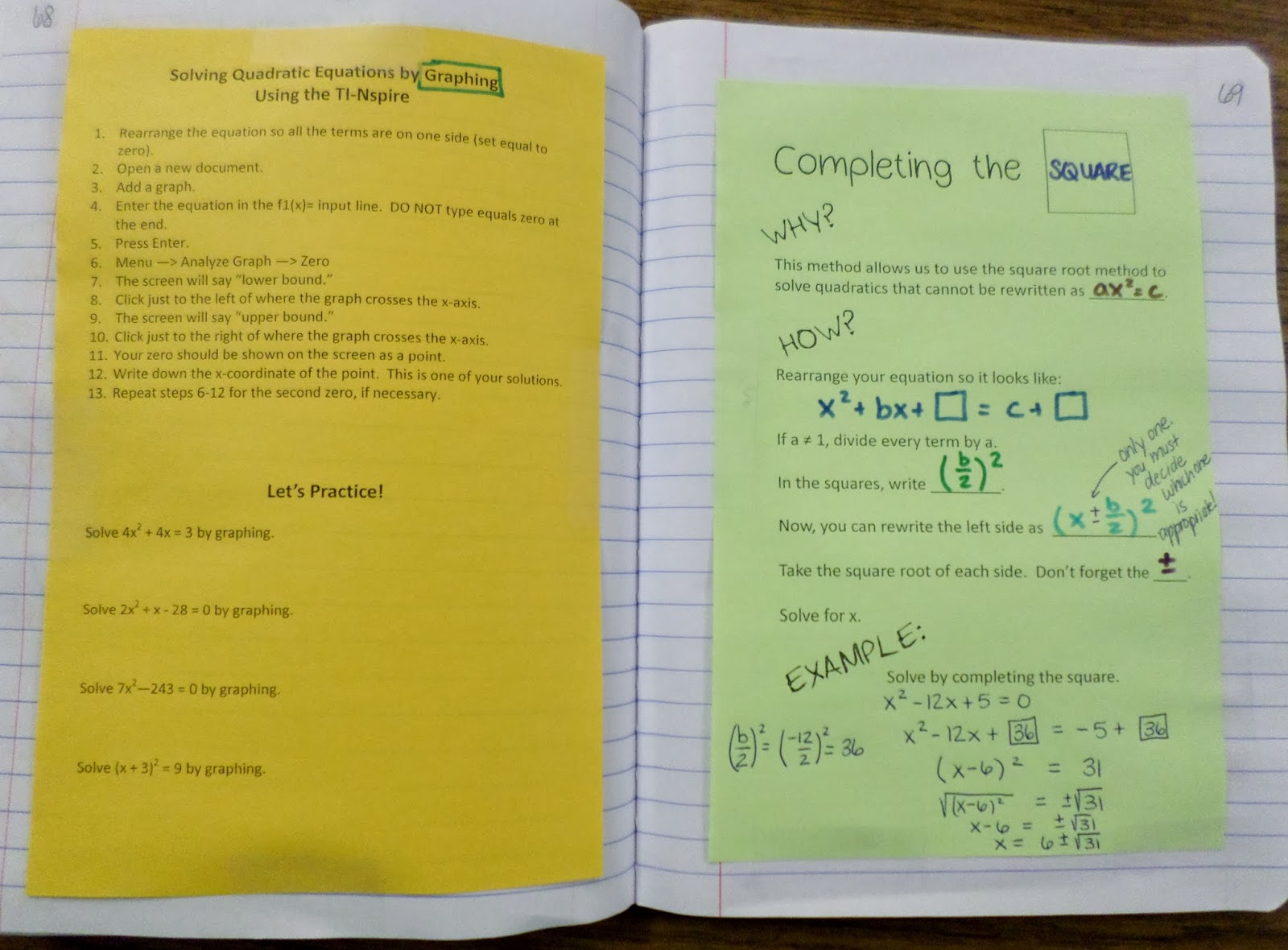
Here's the notes and the facing page for reference.


I'm not completely happy with this lesson, but that's normal.  Every year I strive to teach things better.  I learn by posting my stuff on the Internet for others to modify, tweak, and critique.

Want to download the files?  Click here!

My Favorite YouTube Videos to Show in Math Class

I'm cleaning out my drafts folder in blogger.  Most of my drafts are posts with titles to remind me about what I still need to write about.  Is it bad that I don't remember what some of these titles even refer to anymore?  Delete.  Delete.

Today, I want to share with you the youtube videos I have used in my math classes over the past two years.  It is my hope that I might introduce you to something you haven't seen before.  I guess these could all be individual posts, but that's not gonna happen.  As soon as school starts, I'm going to have a million and one new things to blog about.  So, I want to blog about as much of my old stuff as possible before then.

The first few videos are ones that I show on Pi Day.

(By the way - I'm not sure if these embedded youtube videos will show up if you're reading this blog post via e-mail or RSS reader.  If they don't show up, you may need to click through to my actual site to watch the videos.)

What Pi Sounds Like - Very cool musical version of pi!  My band students especially love this video.


How Pi Was Nearly Changed to 3.2 - A fun little history lesson for students on how pi was almost changed forever.


The Pi Song - Cute song that will help students start memorizing the digits of pi.


Quadratic Formula Song to Adele's "Rolling In The Deep" - Funny story.  I actually heard this version BEFORE I heard Adele's original song.  Now, any time I hear the actual song, I think of it as an adaptation.  Some of my students really enjoyed this.


y=mx+b Song - I like this short slope intercept song.  My students voted it as their least favorite of my slope songs, though.  :(


Colin Dodds - Number Types (Math Song) - I always use this video when introducing the Real Number System.  I love the organization of his graphics!


Slope Music Video (Rise Up Run Out) - This is probably my students' favorite slope song.  They begged me to play it while we were working on homework for the entire rest of the year.  Some of them went out and listened to it on their own time.  Love this song!  I have even found myself singing it in the shower...


Colin Dodds - Slope (Math Song) - Another catchy slope song from Colin Dodds.  I love his stuff!


Graph Shop - Graphing Lines Thrift Shop Parody - I think this was my favorite new math song this year.  I went and listened to the actual lyrics of Thrift Shop after this.  Not good!  One day, my students asked me if I knew who Macklemore was.  I thought he was a character on Harry Potter.  Oops...


Slope Rida - "Slope" - I always use this video in my introduction to slope.  LOVE it!


Nonagon - They Might Be Giants - I've never actually taught geometry, but I still manage to find a way to show this video to my students.  Usually it goes like this - Do you want to hear my favorite math song?  Sure!  Show this video.  For some reason, they are not as excited about it as me.  It always makes for a sad day...


Slope Dude - This post wouldn't be complete without mentioning Slope Dude.  I can't teach slope without him!  This is the video that I hope my students remember until the day they die.  A bit extreme?  Maybe.


Colin Dodds - Pythagorean Theorem (Math Song) - My first year of teaching, my 8th grade Algebra 1 students were also required to take the 8th grade state math test in addition to the Algebra 1 test.  One of the main 8th grade topics is the Pythagorean Theorem.  I used this song as a quick review of that.


Meat-A-Morphosis: An Introduction to Functions - I use this video every time I introduce functions.  The kids are outraged.  And, it leads to all kinds of fun conversations.  Most of these are centered around my decision to be a vegetarian...  But, we also talk about math, too.


Hexaflexagons by Vi Hart - I love making hexaflexagons with my students.  Vi Hart explains them way better than I ever could!


Hexaflexagon Safety Guide - After we make our own hexaflexagons, we watch this video to get some really cool decorating ideas.


Video for Combining Like Terms - This video is a little long, but it makes the perfect introduction for combining like terms.  Watch it.  You'll see why!


Flocabulary - Order of Operations Rap - My students love this order of operations rap.  Apparently, it has a "sick beat."  I guess that's a good thing???  All I know is that students were wanting to download this song on their MP3 players.  In my book, that's a win!


PEMDAS - Don't Stress! - I also love this order of operations song.  Catchy tune!


Graph! (WSHS Math Rap Song) - This was my first year to show this video during our linear equations unit.  My students enjoyed it, but it's a bit long for my taste.


Minor Notes - Slope - My students asked to watch this video one day based on YouTube's recommendation.  I agreed hesitantly.  I try to not let students watch videos I haven't pre-screened.  I made that mistake once.  A student suggested a quadratic formula video and assured me that it was school appropriate.  Then, one of the cartoon characters cut off the other character's head.  Didn't see that one coming!  I decided that anybody who would call themselves Mr. Q - U - E would have to be school appropriate.  The song was okay.  There's a lot of slope songs I like a lot better.  But, my students loved it for some reason.  I think their love might be more for the singer they deemed "handsome" than for the song...


Colin Dodds - Scientific Notation (Math Song) - Scientific notation was another one of the topics that my 8th graders were tested on that wasn't covered in Algebra 1.  They really liked this video.  It provided several opportunities to pause the song and think about the answer before continuing.


The "One Direction" Quadratic Formula Song - Here's another quadratic formula song that we listened to in Algebra 2.  It's to a One Direction song that I'm not really familiar with, but my students were plenty familiar with it.  I still prefer the Pop! Goes The Weasel version...


So - there you have it.  My favorite youtube videos to use in math class.  Do you have any favorites you don't see listed?  Share them in the comments!  I'm always on the lookout for new videos to share with my students.  There are so many of them on Youtube, it can be hard to sort through them to find quality videos.

Algebra 2 Letters of Advice

I gave my Algebra 2 students prompt as my Algebra 1 students.  Write a one page letter of advice to a student taking Algebra 2 next year.  As always, the letters were funny, enlightening, serious, profound, and reflective.  Of course, not all of the letters were all of those things.  There was the student who added an s to the end of every single word in their letter.

My reflections?  Again, I feel like my classroom management problems are evident in these letters.  I got super strict after Christmas.  As a first year teacher, I had 65 students spread out over 6 class periods.  It was heavenly.  This year, I have 85 students in those same 6 class periods.  Used to have so few students, I had few rules, requirements, and procedures in my classroom.  The increase in class size led to an increase in discipline problems.  And, I've had to make a lot of changes to how I do things in my classes.  Next year, I want to set procedures and consequences from the start of the year instead of half way through the year.  I'm expecting even larger class sies next year, so it is imperative that I get a handle on this problem.

My Students Reflect On This Year


I didn't take this class seriously and I failed the eoi.  I disliked taking this class and learning Algebra II.  Once I took Algebra 1 and I passed the eoi and felt good.  I liked making a journal and doing arts and crafts, but I didn't like doing all the worksheets and homework.  I didn't like the fact that I didn't get to chill and didn't get to laugh.  "Ok, you shouldn't be talking."  You will hear this 360,012,140 times this year, and you will never learn not to talk because everyone likes to talk to everyone.  I loved learning about math and great things about graphs on the very smart calculator because you feel like you love to love it!  I loved this class.

Dear Concerned Student,
By reading this letter, you are obviously in Algebra II.  Don't panic, yet.  Firstly, lose your phone.  You'll have it taken within seconds of having it out.  Your teacher, Ms. Sarah Hagan, is an amazing teacher, but she tolerates nothing.  You can't even suggest a movie; she'll just shoot you down!  Don't ever expect to walk into class and do nothing...we always do something.  Yes, that means everyday.  When you start getting into the work, such as notebooks, worksheets, etc, be sure to keep up.  Missing one day of school will be the worst thing you could do. 

This class could be fun if you make it that way.

To whomever this concerns, if you plan on taking this class - stop, reevaluate your life and take another class other than this one, you will not enjoy the pain you will endure in this room.  Just kidding.

The quadratic formula is actually kind of entertaining.

If you're reading this, you're most likely in Algebra II.  I am so sorry.

This class is easy.  Remember your manners and behave for Ms. Hagan, and this year will pass by quick.

If you take one class that you decide to pay attention in, this is it.  At times you might have to sacrifice free time and sleep to complete the work.

Always ask for help, and I can promise you'll receive it.  I spent many lunch periods and afternoons with Ms. Hagan.  She will give you extra help as long as you ask for it.  Try your best not to copy people's work.  It might help you pass the class, but it isn't going to help you pass the EOI.  Throughout the year, you may get some bad grades, but always keep working.  Never give up on trying to succeed.

In Algebra II, you can't get behind.  You will be completely lost and behind all year.  If you just pay attention, it's not that hard.  You've just got to stay on top of things.  If you get confused, come in before school, after school, or during lunch.  That will really help you pass your test.  Make sure you know how to use the graphing calculator, that makes everything much much simpler.

My Students Talk About What To Do And Not Do


My advice to a student that plans on taking Algebra 2 next year is to actually try in class.  If you miss one day or even one hour of this class you will be so far behind its not even funny...Don't cheat either because that won't get you far.  It will just bring you more work and it will make it harder for you.

Make sure you don't talk a lot during class because Ms. Hagan will kill you.

Refrain from sleeping.  It doesn't help you.

This class can be a challenge.  You'll fail quizzes or possibly tests.  Be sure to limit yourself from distractions.

If you don't pay attention you will be lost and confused easily.  This class can be very fun and easy to remember the stuff you learn in this class if you just listen, pay attention, and do your work.  You need to keep up with your work or you will fail.

My advice to you would be don't procrastinate; finish your work asap.  If you ever need help don't be afraid to ask Ms. Hagan.  She will help you and doesn't make you feel stupid while doing so.

P.S. Don't be like me.  Keep your cell phone put away.

Try to consciously understand what she is teaching and if you don't then ask for help.  Keep your phone away in class because it will do nothing but distract you.  Be sure to keep your notebook up to date because it is your road map to Algebra 2.  The number one thing is DON'T GET BEHIND.  Everything in this subject builds on what you were just taught

Do not ever show up to class without your notebook or pencil.  Do not copy off someone you will not learn anything...Don't ever have your phone out because you will get it taken away.  You need to always pay attention...It would be really smart to stay quiet and listen because if you don't you will get yelled at and sent off to the office.  Take this advice really seriously.

Don't sit by one of your friends because it makes it hard to learn anything in this class.  Don't miss anything in your notebook because it helps a lot in class.  Be very respectful of Ms. Hagan because it will help you because she can make this class a lot easier.

Just pay attention in class and actually do your work by yourself.  If you have a question don't be afraid to ask Ms. Hagan won't bite your head off.  She actually likes you when you ask questions."

More advice: keep your work turned in.  Zeros will kill you, and surprisingly it helps you understand your work better if you do your homework.

If  you're copying someone, make sure your partner isn't as stupid as you are.

This class can be fun if you let it be.  Step 1 - do not have your phone out the first semester or you will have a terrible version of Ms. Hagan the 2nd semester.  Step 2 - treat Ms. Hagan with respect or you will get the same result.

Make sure to do all your assignments and show all your work.  Do not sit by your friends because you will get extremely behind.

#1 Rule: Make sure you don't have your phone out in class when the bell rings or she will take it.

My Students Talk About Notebooks and Calculators


Algebra 2 is a fun class.  Lots of meaningful, colorful notes...You get awesome calculators.  You fold and make cool things.  Hope your year was as fun as mine.

You'll probably love the notebooks because they're very helpful.  I loved them when I had homework.

This class is fun but difficult at the same time.  There are these amazing things called graphing calculators.  Make sure you pay attention when you learn new things about them and you will for sure pass.

You will need a notebook and you will fill up every page and you will color and glue and cut out things all the time.  You will feel like you're in preschool again.

One of the most important things you can do in this class is show your work, even if she doesn't say you have to (which she usually will).  Another thing that helped in this class was I learned how to use the calculators, but I would use them as little as possible.

Pay attention on how to use the calculator.  It will be your best friend in the classroom while you're doing your work.

My advice for you would be to listen to her instructions, turn in all work, number the pages of your notebook, write down the titles for each section in your notebook when you do that section that day, and learn how to use your calculator because they will help you so much for the test.

You also need to learn how to use a graphing calculator because it will be your best friend in this class.

This class is very good.  Your teacher is the best teacher in the whole high school...I love this class because the teacher is an awesome one.  You will be making notebooks instead of using your books.  The notebook is my favorite part of this whole class.  You get to use graphing calculators.  They are the most useful things in this whole class.  You can use the calculators for almost everything in this class.  When you go over long division, pay attention.  There is questions on the EOI.  Don't freak out.  You get to use your calculator.  The class will get you very prepared for the test.  This class is not very easy.  You have to pay attention all the time.  You will get in trouble often if you talk.  She does everything on the Smart Board.  You are not allowed to have your phone on in class.

Hopefully you like coloring, writing, folding, and cutting because you will do a ton of that in your notebook.  When cutting the papers for your notebook make sure you ask before you start cutting away on your paper!

Don't mess up on one thing in your notebook because if you miss one thing it's a zero so take the time to make sure it's all finished.

Stay focused on your work especially the notebook.  You will be writing A LOT in this class.  Your notebook is a huge part of your grade.

The notebook is IMPORTANT.  She will fail you if you do not have it.


My Students Talk About Me


Ms. Hagan don't play games.  She's on a mission.  She is gonna teach you no matter what you want.  She will teach different ways to do everything.  So you have plenty of ways to do each problem.

Ms. Hagan is a super good teacher so she'll help you out a lot.  But be sure to always give her your full attention; especially after Christmas break, just saying.

Having Ms. Hagan as a teacher really helped me understand math a lot better.  She's really good about staying after school to help you fix your grade and make sure you pass.

If you want to be on Ms. Hagan's good side, just do what she asks and pay attention.

Ms. Hagan can be cranky.  On those days, it would be best to just do the work and avoid looking her in the eye.

Ms. Hagan is a phone Nazi, so keep the thing hidden.

Also she does not care if you have a job or not she still wants her packet.

She made math easy and fun.  If you don't get something the first time going over it, then just be patient.  You'll get it eventually.  Never ever I mean ever get your phone out in her class.  You will lose it.

My Students Talk About Killing The Cat


P.S. Don't kill the cat; you will learn about this next year!  It is really important!

Even if you hate cats, don't kill the poor thing.

Another important thing is to never kill the cat.  I don't think anyone really understands this rule, but I guess it worked.

Don't kill the cat (not quite sure what it means but she gets ticked about it.)

Oh, DON'T KILL THE CAT!! It upsets her...

 My Students Give Random Advice


You may never use any of this in real life, but the State of OKLAHOMA makes you learn it.  Sounds stupid but you have to!

Stay classy, not trashy!

P.S.S. Do math, not meth.

So good luck.  May the odds be ever in your favor.

Yous musts be goods ats algebras.  Dos nots sleeps.  Yous justs steppeds intos as years ofs tortures.  Pays attentions tos everythings.  Don'ts copies offs peoples.  Haves as goods times.  Don'ts kills thes kats.

Welcome to one year of torture with Professor Sarah Hagan.  Are you prepared for an extremely challenging year in which you shall most likely lose all sanity?  Well!  You should be!  I hope you survive this year of suffering and despair with all of your sanity in tact.

Solving Quadratics by Square Roots

One of my students' favorite ways to solve quadratic equations is by square roots.  I covered solving by square roots after solving by factoring.  Since my Algebra 2 students still struggle with factoring fluently, solving by square roots is like a breath of fresh air to them.  They get it.  Square roots are accessible.  However, they have a tendency to forget that the square root of sixteen is not just four.  It's positive or negative four.  No matter how many times I emphasize it, they can't seem to remember the plus or minus sign in front of their answer.

This year, I decided to remedy this by putting an obnoxiously large plus or minus sign in their notebook.  We took the notes on top of the plus or minus sign.  These are the same plus or minus signs that I used last year for graphing different types of slope in Algebra 1.  I love finding new uses for files I've already created!

Solving a Quadratic Equation by Square Roots - Interactive Notebook Page
I wish I could say that this method was fool-proof.  I wish I could say that my students never forgot the plus or minus sign in front of their answer.  But, then, I'd be lying to you.  I do think that this visual helped some of my students, though.  

Here's the two-page spread in our interactive notebooks.  I have yet to blog about the Zero-Product Property and Solving Quadratics by Factoring yet.  They're coming, though.  I promise.  Pinkie promise.  

Solving Quadratic Equations INB Pages

You may download my quadratic function files below.  If you have trouble accessing the file, please send me an e-mail.  I will be happy to attach the files and send them your way!


Different Forms of a Quadratic Function - Foldable and Flyswatter Game

As this school year starts to come to a close, I'm reflecting on what worked and what didn't work.  Yes, I realize it's only the beginning of March.  We haven't even had Spring Break yet.  But, I've woken up to the realization that I have 20 school days left with my students before end-of-instruction testing begins.  20 days.  20 days!  I did this counting on Friday when our counselor e-mailed out the standardized testing schedule.  I pulled out my calendar and counted.  23 days.  Then, we had two snow days.  Awesome.

I'm currently working on a plan to figure out how to tie up all the lose ends before testing.  My Algebra 2 students have yet to do polynomial long division, solving rational equations, composition of functions, or operations with functions.  My Algebra 1 students still need to learn solving systems by substitution, solving systems by elimination, graphing linear inequalities, graphing absolute value graphs, and simplifying radicals.  My, oh my!  It is going to be a sprint to the finish!

You could say I'm in panic mode.  Want to see where my priorities are, y'all?  I'm even more panicked than I felt when I saw this a few weeks ago.  There's nothing like a facebook app telling you that you have 23 days left to get married.  I took a screenshot of this, hoping to spark a good conversation with my statistics students.  Why is or is not this a representative sample of my facebook friends?  What are the dangers of drawing conclusions from this?  I still need to get around to this...

23 days...
Okay.  Back to the topic of hand.  What has worked well?  What do I need to change for next year?

This year, I feel like I did a WAY better job with quadratic functions in Algebra 2.  Way better.  Let's be honest.  It wouldn't take much to do a better job than last year.  Last year, I didn't even teach my students the names for the different forms of a quadratic function.  We did all our graphing using the calculator last year, so I didn't think it really mattered.  This year, I made it my goal that students would identify the form of a quadratic function first.

Here's how I went about this.  We made a foldable with the equations of each form of a quadratic.  Day 1.  No notes on the inside of the foldable.  Just the formulas on the outside and the names of each form.  (Note: This isn't all we did on Day 1.  First, we got into groups and practiced matching up the parabolas from our conic cards!)

Here's how I modeled it on my SMART Board.

How to Graph Quadratic Functions

Here are the names of the forms.  Here are the formulas.  What do you notice?  How can you tell them apart?  Vertex form has parentheses.  Doesn't intercept form have parentheses, too?  The parentheses in vertex form have an exponent of two.  Now, we're getting somewhere.  Intercept form will always have two sets of parentheses.  Will it?  Are you sure?  They continued throwing out ideas on how to tell the different forms apart.  I'm kinda glad I had them have this conversation as a class before we ever started trying to classify quadratics by their form.  

Flyswatter Game


We played one of my favorite games for classifying stuff.  The Flyswatter Game!  

Quadratic Functions - Flyswatter Game

Two teams.  Throw a picture of a function on the SMART Board.  First player to correctly swat the correct form on the dry erase board gets to stay in the game.  Other player has to sit down.  Two new players go to the board.  Another function.  Another showdown.  Winner stays in the game.  Loser sits.  Game continues until only one team is left.  
Quadratic Function Forms Flyswatter Game
Practice, practice, practice.  I made a slight change to the flyswatter game this time around, though.  I had students who weren't playing at the time stay in their seats.  They used their notebooks to determine the form.  Students at the board had to determine the form without their notebooks.  Students with notebooks "graded" the work of the students at the board.

The best part of the game was hearing students explain to other students why their classification was wrong.  "But, it can't be in standard form.  It has parentheses.  Standard form will never have parentheses."  Students teaching students.  Win!

On Day 2, we went back to our foldables.  We added in instructions on how to graph quadratics depending on their forms.  This foldable, by the way, is made from a single sheet of paper that has been cut in half hamburger/taco style.  Lay the two layers of paper on top of each other.  Scoot the top layer up an inch or so.  Bring the top of the paper down to bottom of the paper to create four flaps.  Staple.  Take notes.  Enjoy.

How to Graph a Quadratic Function Foldable - Outside

Vertex Form of a Quadratic Function Foldable

The bottom of each section contains important information about the equation and its graph.  The top of each flap contains an example.

Intercept Form of a Quadratic Function Foldable

Standard Form of a Quadratic Function Foldable
After we created this foldable, we went back to the functions from the flyswatter game.  Again, we would determine the form.  But, this time we had the necessary tools to graph the function.  We graphed the functions on mini dry erase boards, and students held up their boards to be checked.

Next year, I want to set out to make this even better.  Ideas?  Do you explicitly teach the different forms of a quadratic function?  I'd love to hear from you in the comments!

Solving Quadratics by Graphing

I'm still trying to get my Algebra 2 Quadratic Function Unit up in bits and pieces.  I required my students to demonstrate mastery with 5 different methods of solving quadratics.  I presented them in this order:

* Solving by Factoring
* Solving by Square Roots
* Solving by Graphing
* Solving by Completing the Square
* Solving by The Quadratic Formula

One of the first things we did after learning to graph quadratic functions was to discuss what it means to solve an equation.

Solve A Quadratic Equation INB Pages
We completed a Frayer Model for the phrase "Solve A Quadratic Equation."  

Solve A Quadratic Equation Frayer Model
This year, I am using the TI-Nspire graphing calculators with my Algebra 2 students.  As someone who was trained to use a TI-84 in high school and a TI-89 in college, this has been a big change for me.  But, I've learned to love the Nspire.  I have yet to decide which calculator I will use with my students next year as we transition to Common Core, however.  

I typed up these steps for my students to glue in their notebooks in case they forgot the process to find the solutions graphically.  We did four problems together as practice.    

Solving Quadratics by Graphing - INB Page

If you would like to download my Quadratic Function files, they are embedded below.  If you cannot get these files to open, please send me an e-mail.  I will be happy to attach the files and send them to you.


The Discriminant Is Our Friend!

Yes, I realize that I'm posting this out of order.  The last topic we covered in our Algebra 2 unit over quadratic functions was the discriminant.  So far, I've posted about our first activity.  Now, I'm posting about our last activity.  Eventually, I get all of this unit posted.  I promise!

At this point, my students have already memorized and practiced applying the quadratic formula.  I instruct them to open their notebooks to page 72 and title the page "The Discriminant Is Our Friend!"

The Discriminant Is Our Friend
Of course, a student asks me if I am racist.  Ahem.  The discriminant is our friend.  NOT discrimination is our friend.  There is a definite difference!

Moment of Honesty: Last year, I didn't even teach my Algebra 2 students about the discriminant.  Last year, my unit on quadratics was less than stellar, and that was reflected in our test scores.  Of all the topics covered in Algebra 2, my students performed the absolute worst on quadratic functions.  This year, I set out to change that!

Discriminant is a scary sounding word.  But, my students soon realized that it was really no harder than the quadratic formula.  I'm hoping that one of the things that my Algebra 2 students take away from my classroom is that scary sounding terms are not necessarily difficult.  For example, lots of students came to love logarithms.

We created a foldable in our notebooks that was shamelessly stolen 100% from Nora at Simplifying Radicals.  I had trouble getting her Word File to open for me correctly, so I ended up having to retype the foldable.  But, all of the material is hers!  


Discriminant Foldable - Outside

On the outside, we labeled the four flaps.  One flap contains basic information about the discriminant.  The other three flaps contain examples where the discriminant is equal to zero, greater than zero, and less than zero.

This was the first time my Algebra 2 students had ever made a foldable in this style.  When the flaps are unfolded, there are 16 squares to write in.

My students' only complaint was that the squares were too small.  I didn't have any trouble writing in the squares, but I did have to use pen instead of marker due to size constraints.

Discriminant Foldable - Inside

We took to referring to the different parts of the foldable as quadrants, named as the quadrants of the coordinate plane.

In the second quadrant, we discussed what the discriminant was.

What is the Discriminant?

The third quadrant contained an example to work out where the discriminant is greater than zero.

When the Discriminant is > 0

The fourth quadrant contained an example where the graph had no real solutions and two imaginary solutions.

When the Discriminant is < 0.

The first quadrant was an example of a quadratic equation with one real solution.

When the Discriminant is = 0.

This foldable took longer to complete than I anticipated (about 1.5 50 minute class periods), but I think it was well worth the time.

To find out more about this foldable, be sure to check out the Simplifying Radicals blog.
Older Post ►
 

Copyright 2011 Math equal LOVE is proudly powered by blogger.com